
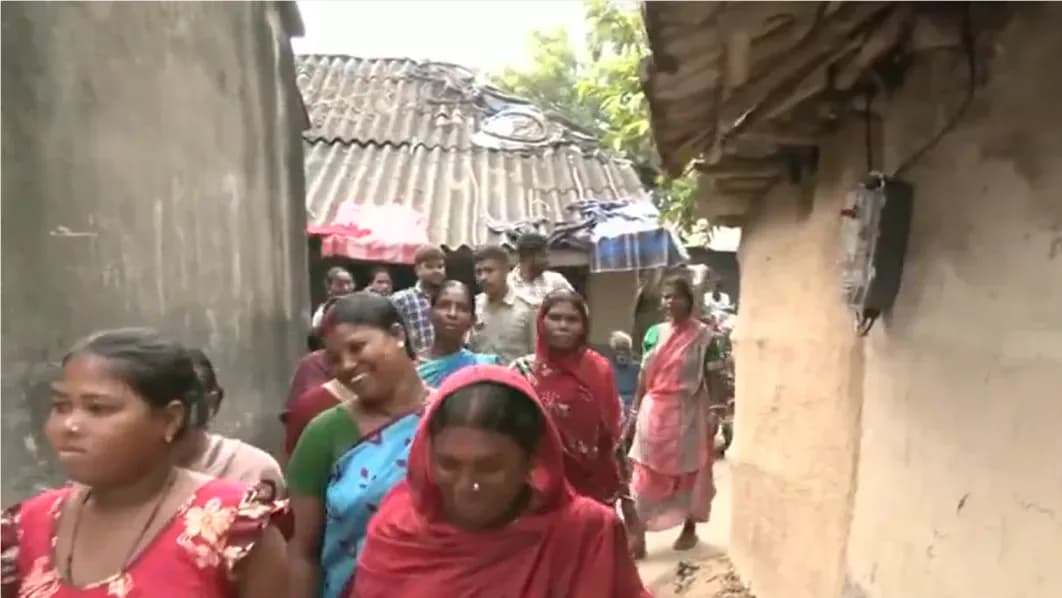



Nearly 79 years after India gained Independence, electricity has begun reaching Chakdah, a village in Hooghly district of West Bengal that is home to around 400 Adivasi families.
The development comes ahead of Diwali, but the work is still underway. Reports say meter boxes have been installed in 50 houses, while connections are being extended to more than 100 households.
#WATCH | Hooghly, West Bengal: Chakdah village under Ashtaradattapur Gram Panchayat in the Tarkeshwar Assembly constituency receives electricity for the first time since Independence. Around 400 Adivasi families are set to celebrate the Diwali festival with a new ray of hope as their village gets its first-ever electricity connection. (05.11)
— ANI (@ANI) November 5, 2026
Also Read | 17 dangerous glacial lakes in Bhutan trigger flood alert, Bengal on high alert
The poles were there; the power was not
Chakdah falls under Ashtaradattapur Gram Panchayat in the Tarakeswar Assembly constituency. For years, electricity poles stood in the village, but residents say the wires were never laid.
Without the connecting lines and household infrastructure, the poles did not translate into a usable electricity supply. The result was a long gap between the appearance of electrical infrastructure and the arrival of power inside homes.
Local residents told news agency ANI that about 400 families had been living without electricity. They said children found it difficult to study after sunset, when homes had no regular lighting. For families without a reliable power connection, even routine household activities remained difficult.
#WATCH | My Report from Chakdah Hooghly INDEPENDENCE KE BAAD PEHLI BAAR… THIS VILLAGE GETS ELECTRICITY! Electric poles are standing. Cable wires are hanging. But for decades after Independence, the village remained without electricity! 📍 Where: Chakdah village, under Ashtaradattapur Gram Panchayat, in the Tarkeshwar Assembly constituency, Hooghly. Why was this village left in darkness for so long? Locals allege that the village was neglected because they supported the BJP. Well… finally, a new chapter begins! 🪔 “This Diwali, REAL ROSHNI finally enters their lives!” Credit also goes to @Santu_republic #Hooghly #Electricity #Chakdah #Tarkeshwar #WestBengal #VillageDevelopment #Diwali
— Sonu D Ojha (@sdo_ojha) November 6, 2026
A promise, a charge and a connection drive
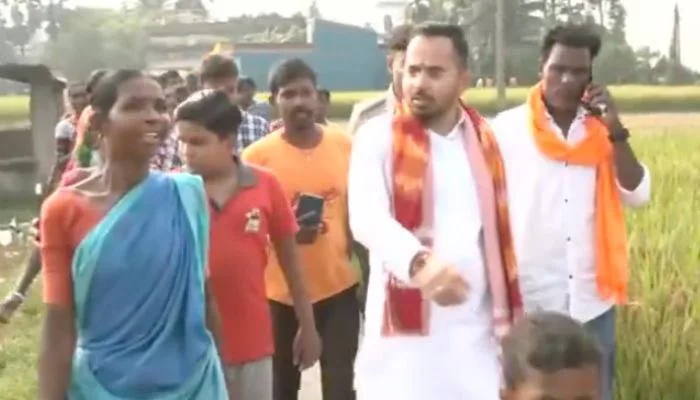
The reason for the delay has become a political issue. BJP MLA Santu Pan, who represents Tarakeswar, alleged that the village was denied electricity because residents had consistently voted for the BJP since 1997-98.
He said he had heard residents’ concerns during his election campaign and promised to make electrification a priority if elected.
In footage carried by ANI, Pan said: “For the first time since independence, an electricity connection has reached this village.”
The allegation that the previous Trinamool Congress government withheld electricity for political reasons has also been raised by some residents. However, this has not been independently established.
The immediate change has come through a household connection drive. According to Pan, the district electricity department began installing meters around a month before the reports of the development.
Fifty houses have received new meter boxes, while more than 100 households are being brought into the connection process. Pan also said families listed below the poverty line (BPL) would receive free electricity connections.
Also Read | Swasthya Sathi under scanner as Ayushman Bharat drive finds 20 lakh beneficiaries untraceable
The last mile is where the lights must come on
The gap between electricity poles and household connections is important in understanding rural electrification.
Connecting a village to an electricity network and ensuring that each household has a working connection are not the same task.
The Union Ministry of Power makes this distinction in its account of rural electrification schemes. The Deen Dayal Upadhyaya Gram Jyoti Yojana (DDUGJY), launched in 2014, focused on connecting inhabited, un-electrified census villages.
The Pradhan Mantri Sahaj Bijli Har Ghar Yojana, better known as Saubhagya, launched in October 2017, aimed to provide electricity connections to all willing un-electrified households.
According to the ministry, states and Union Territories reported that all inhabited un-electrified census villages had been electrified by April 28, 2018. They also reported that electricity connections had been provided to all willing un-electrified households by March 31, 2019.
A total of 2.86 crore households received connections during the Saubhagya period.
However, the responsibility for electricity supply and distribution in rural and urban areas rests with state governments and distribution utilities. The Centre supports these efforts through various schemes.
Under the ongoing Revamped Distribution Sector Scheme (RDSS), the Ministry of Power said on February 12, 2026, that on-grid electrification works had been sanctioned for 13.65 lakh households. Of these, 2.93 lakh households had been electrified at the time of the statement.
Chakdah’s experience highlights why national electrification figures must also be viewed through the lens of last-mile delivery. Installing electricity poles is only one part of the process.
The wires must reach the settlement, homes need individual connections, and households must receive a functioning power supply. For Chakdah’s residents, that process has finally begun.