








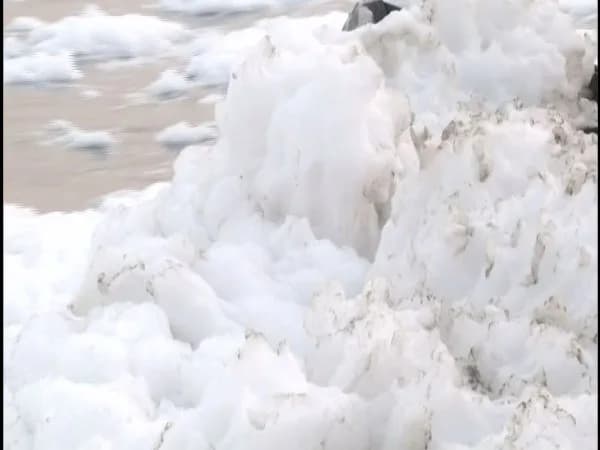
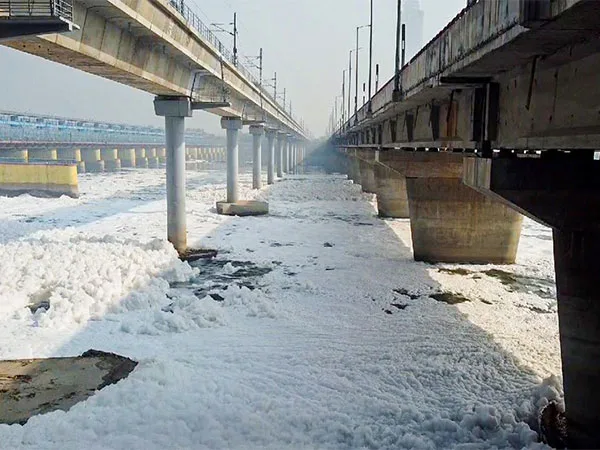
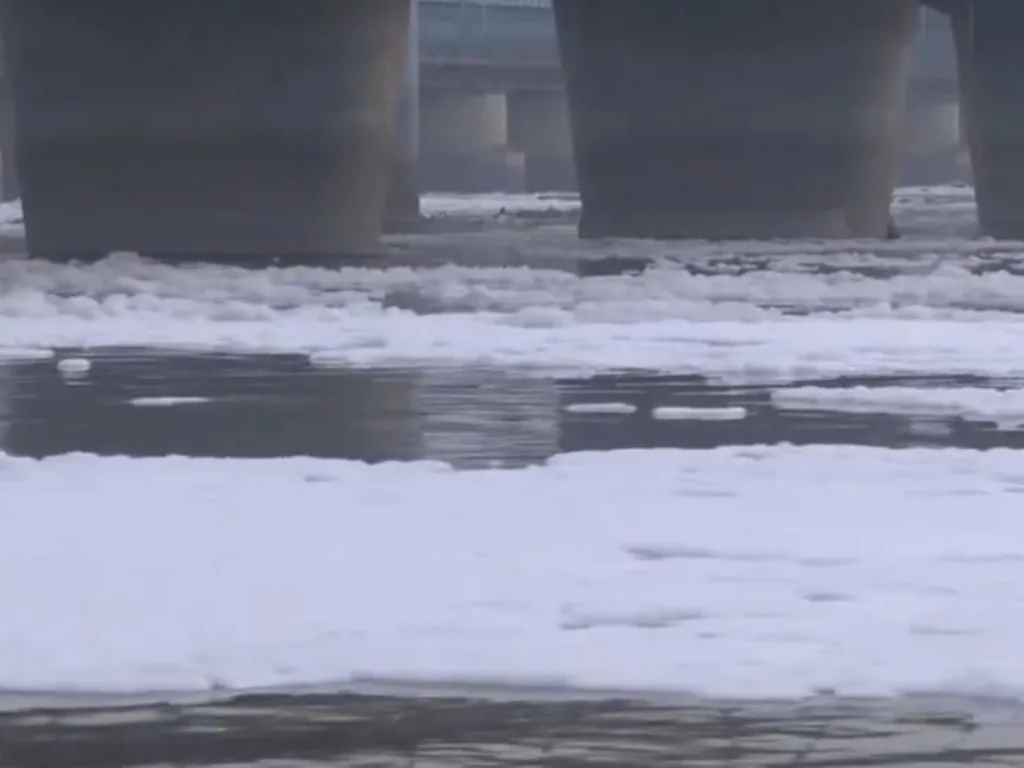
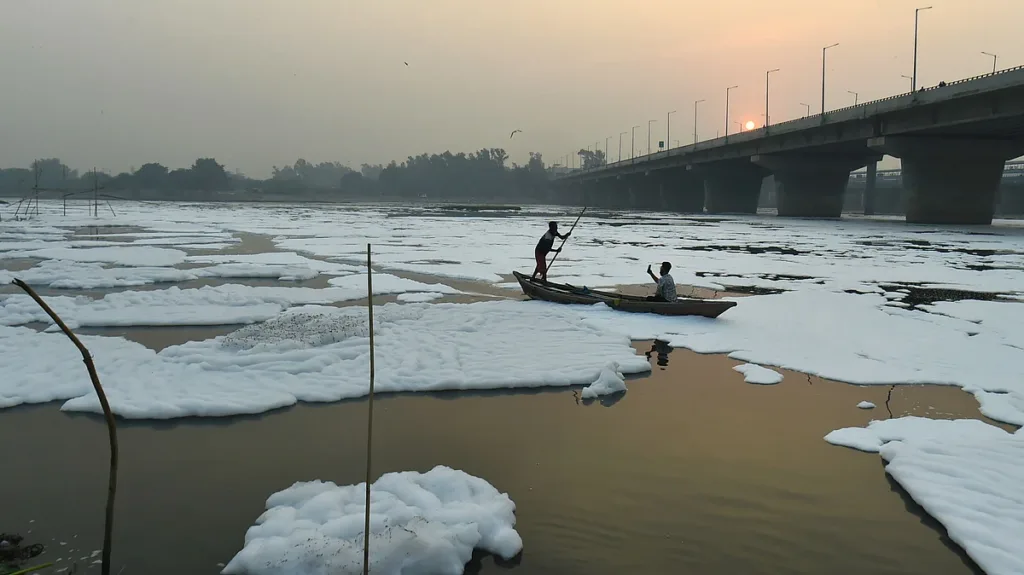
The return of thick white foam on the Yamuna near Kalindi Kunj has once again brought Delhi’s river pollution problem into focus. As workers struggle to clear the froth and prevent further contamination, a Swedish company specialising in sewage sludge management has approached the Delhi government, expressing interest in contributing to the clean-up effort.
Representatives of the company recently met Delhi Water Minister and Delhi Jal Board (DJB) Chairman Parvesh Verma at the Delhi Secretariat. According to the government, the discussions centred on exploring possible areas of cooperation in sewage sludge management. While no formal agreement has been announced, the development comes at a time when Yamuna pollution continues to expose the limitations of the capital’s existing waste management infrastructure.
The white foam, which frequently appears along the river during winter, is associated with detergents, untreated sewage and other pollutants entering the water. However, the problem extends well beyond the visible froth. Several drains continue to discharge contaminated water into the river, raising questions about the effectiveness of Delhi’s sewage treatment and monitoring systems.
Yamuna pollution exposes gaps in Delhi’s sewage management
A recent study by the Central Pollution Control Board (CPCB), released last month, identified 12 drains as major pollution hotspots along the Yamuna. The assessment also found waste dumped at 32 locations, while arrangements to prevent contaminated water from entering the river were either inadequate or non-functional at 11 drains.
The extent of Yamuna pollution becomes particularly evident when water quality readings are compared across different locations in Delhi.
At Palla, where the river enters the national capital, the biochemical oxygen demand (BOD) level remained within the prescribed bathing-water limit in September. However, by the time the Yamuna reached the ISBT Bridge, the reading had increased to 30 mg per litre, ten times the permissible limit.
BOD measures the amount of oxygen required by microorganisms to break down organic matter in water. Higher readings indicate greater organic contamination and can adversely affect aquatic life. The sharp increase in BOD levels highlights how the river’s condition deteriorates as it passes through Delhi.
The recurring foam near Kalindi Kunj is therefore only one visible symptom of a much larger environmental crisis. Unless untreated sewage, industrial discharge and accumulated sludge are addressed at their sources, temporary measures to remove the froth are unlikely to bring lasting improvements.
Also Read | BJP links Neha Bora’s temple remarks to Congress, revives ‘anti-Hindu’ row
Delhi government turns to international expertise
The Swedish company’s interest is part of the Delhi government’s broader attempt to bring international technology and expertise into its Yamuna rejuvenation programme.
Verma said cleaning the river would require the best available technology, global expertise and sustained efforts. He also stressed that the government’s approach would extend beyond the river itself to improving Delhi’s overall water supply and sewage management infrastructure.
The capital has already experimented with foreign technology to tackle its drainage problems. In January, the government deployed a Finnish-made Watermaster machine in the Najafgarh drain to remove accumulated silt, sludge and weeds.
Verma has previously stated that the Najafgarh drain accounts for nearly 70 per cent of the pollution entering the Yamuna, making its rehabilitation a crucial part of the clean-up strategy.
Japan has also emerged as an important international partner in Delhi’s water infrastructure development. On October 22, four water and sewage facilities constructed or upgraded with assistance from the Japan International Cooperation Agency (JICA) were inaugurated.
The projects, involving an investment of approximately Rs 1,810 crore, include sewage treatment facilities at Okhla, Rithala and Kondli. These installations are expected to strengthen the city’s capacity to process wastewater before it enters natural water bodies.
Also Read | Rahul Gandhi renews debate challenge as Amit Shah offers Parliament session
Yamuna cleaning target set for May 2029
Apart from the Swedish and Japanese initiatives, the Asian Development Bank (ADB) is associated with a proposed Rs 2,574-crore project aimed at improving water supply in areas served by the Wazirabad water treatment plant.
The involvement of multiple international agencies reflects the scale of investment and technical intervention required to address Yamuna pollution. However, the effectiveness of these initiatives will ultimately depend on whether Delhi can improve sewage collection, treatment capacity and the management of its extensive network of drains.
The BJP-led Delhi government has set May 2029 as its target for cleaning the Yamuna’s stretch through the capital. The deadline places considerable responsibility on the administration to ensure that ongoing infrastructure projects translate into measurable improvements in water quality.
The proposed Swedish collaboration could bring additional expertise in handling sewage sludge, an important but often overlooked component of wastewater management. However, discussions are still at a preliminary stage, and the government has not announced a formal agreement or a detailed implementation plan.
For Delhi, the challenge is no longer simply removing the white froth whenever it appears. The real test will be preventing untreated waste from reaching the river in the first place. Without sustained action against the sources of contamination, the Yamuna’s recurring pollution crisis is unlikely to disappear, regardless of how many international partnerships the capital pursues.