













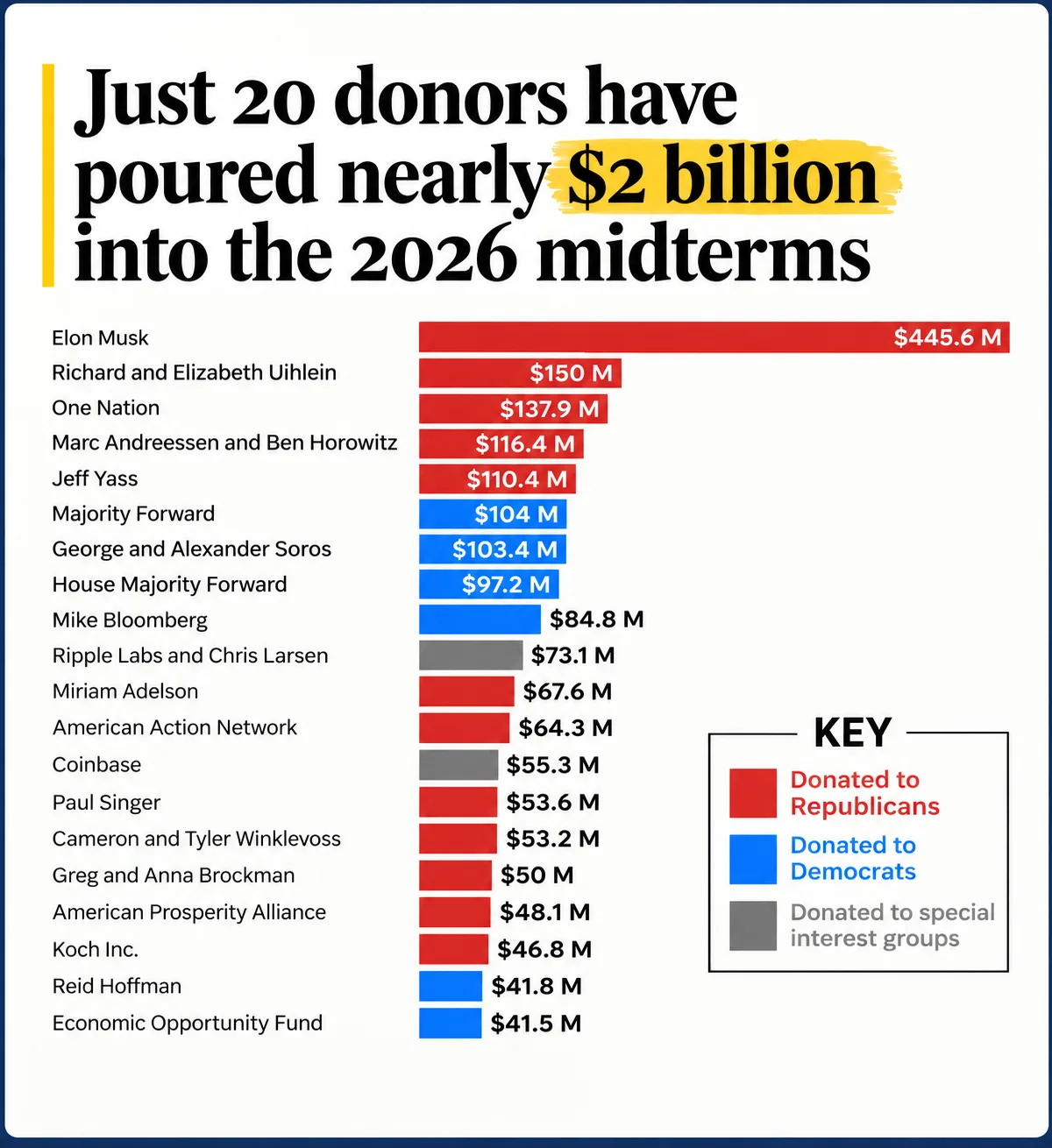
The 2026 US midterm elections have exposed a striking gap between campaign spending and electoral success. Outside political groups spent at least $2 billion on Senate races, separate from the money spent directly by candidates.
Yet Republican-aligned groups spent substantially more than Democratic-aligned groups and still saw their side lose at least seven Senate seats.
Also Read | Democrats have beaten Trump at the ballot box. Now comes the harder test
The considerable cost of an unexpected outcome
The figures are part of a wider campaign finance story. The nonpartisan watchdog group OpenSecrets expects the 2026 midterms to be the most expensive US midterm elections on record.
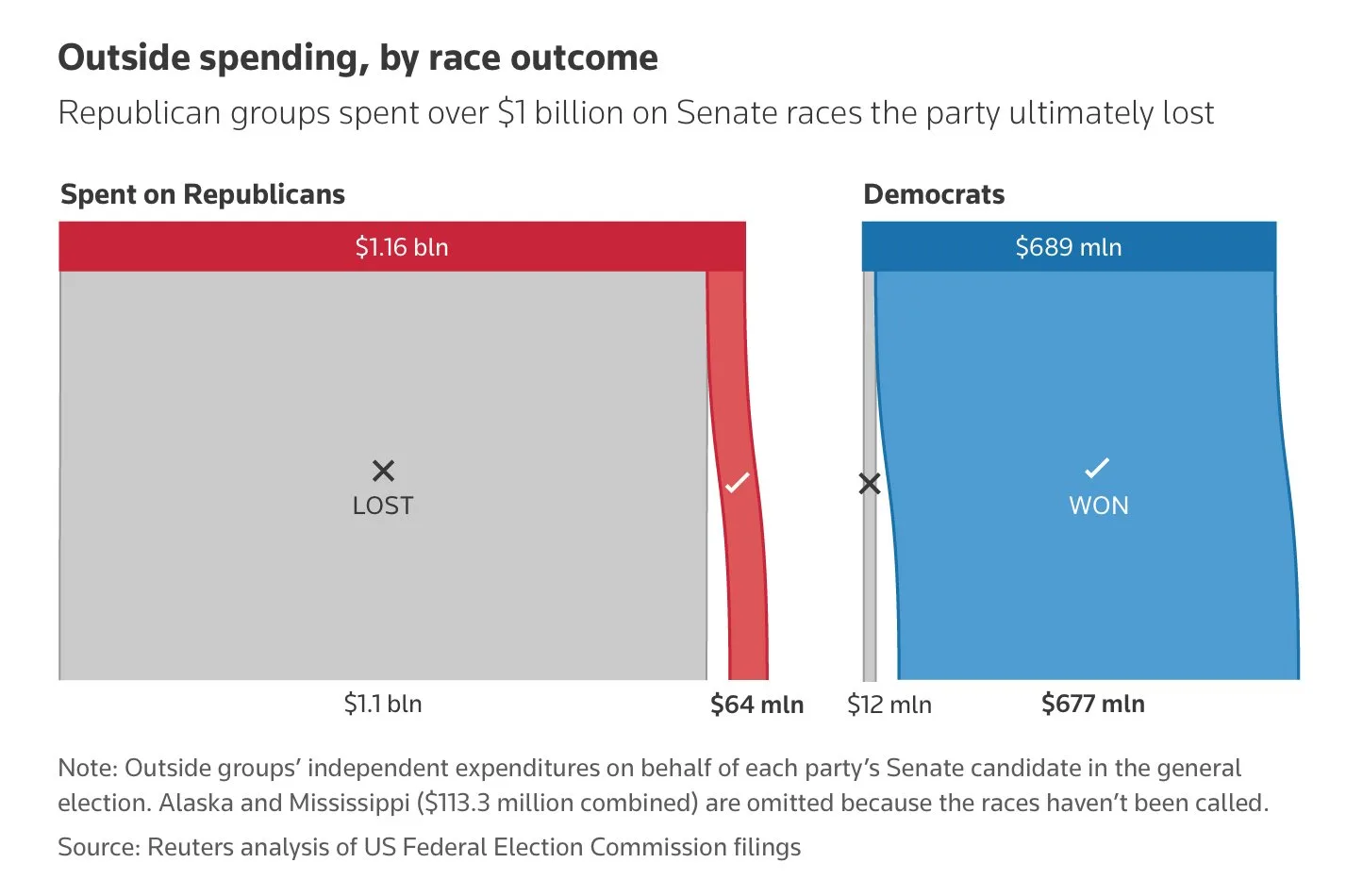
Groups backing Republican Senate candidates spent around $1.16 billion. Those aligned with Democrats spent approximately $689 million. The Republican total was roughly 60% higher. But the final results did not follow the same pattern.
The difference becomes clearer when spending is compared with the outcome of each race. Of the $1.16 billion spent by groups backing Republican candidates, about $1.1 billion went towards races that Republicans lost.
Just $64 million was spent in support of Republican candidates who won. On the Democratic side, the pattern was almost the opposite. Groups backing Democrats spent $677 million on candidates who won and just $12 million on candidates who lost.
The data excludes Alaska and Mississippi, where the Senate races had not been called at the time of its analysis.
Beyond the candidates’ coffers, a parallel purse
To understand these figures, it helps to know what outside spending means in US politics. A candidate’s campaign raises and spends money directly. It pays for staff, travel, campaign offices, advertising and other election activities.
Outside groups operate separately. They can spend money on advertisements, online campaigns, television spots, newspaper ads and direct mail that urge voters to elect or defeat a clearly identified candidate.
The Federal Election Commission (FEC) says such spending qualifies as an independent expenditure only when it is not coordinated with a candidate, campaign or political party.
These expenditures are not subject to the same contribution limits as donations made directly to candidates, although reporting rules apply.
Super PACs and the business of independent spending
Some of these groups are Super PACs, formally known as independent-expenditure-only political committees. Unlike traditional PACs, Super PACs can accept unlimited contributions, including from corporations and labour organisations, to fund independent political spending.
However, they cannot legally coordinate that spending with the candidates they support. This distinction matters.
A large donation to a Super PAC does not mean the candidate can simply use that money as campaign funds. Instead, it gives the outside group the ability to run its own political messaging.
Texas delivers a most curious electoral twist
Texas offered the clearest example of the spending imbalance. Elon Musk and other wealthy Republicans spent $316 million to support Republican state Attorney General Ken Paxton.
Democratic groups spent $109 million backing James Talarico. Talarico’s own campaign also raised more than $146 million directly. Despite the much larger outside spending on the Republican side, Talarico won the race.
Republican-aligned groups outspent Democratic groups by $97 million in Ohio and $76 million in Michigan. Democratic candidates won both contests.
In Iowa, Democrats spent $9 million more, and their candidate also won.
Also Read | Eisenkot gets 67 recommendations, but forming Israel’s next government won’t be easy
Money talks, but voters have the final word
The spending pattern changed as the campaign progressed. Outside groups reduced spending in Georgia and North Carolina as Republican candidates lost ground.
Money moved instead towards races that appeared more competitive, including contests in South Carolina, Kansas and Mississippi.
This suggests that political spending is not always a fixed investment made months in advance. Groups can shift resources as polling, campaign conditions and the perceived chances of victory change.
Advertising can help candidates reach people, shape the debate and draw attention to an issue. But spending cannot guarantee that voters will support the candidate receiving the most outside help.
Candidate appeal, local concerns, party sentiment and the wider political mood also shape election results.
The 2026 Senate races show that even a substantial financial advantage can fail to translate into votes.