




Reporters Without Borders (RSF) has urged the West Bengal government to take immediate steps to protect journalists, citing allegations of legal harassment, online abuse and attacks against media organisations since the Bharatiya Janata Party (BJP) came to power in the state in May 2026.
The press freedom organisation has raised concerns over several incidents involving journalists and news outlets, including Bengali daily Anandabazar Patrika and independent digital publication Maktoob Media. RSF called on Chief Minister Suvendu Adhikari to ensure that journalists can report without intimidation, censorship or violence.
The BJP’s victory in the April 2026 Assembly elections ended 15 years of Trinamool Congress (TMC) rule in West Bengal. RSF had previously called on the state’s new government to make journalists’ safety a priority.
West Bengal government’s media restrictions under scrutiny
One of the first issues highlighted by press freedom advocates was a government circular issued in May 2026 restricting civil servants from communicating information to the press without official authorisation. The directive also prohibited government employees from participating in media programmes produced by private entities without prior approval.
The Internet Freedom Foundation (IFF), an Indian digital rights organisation, argued that the circular imposed broad restrictions on communication with the media. Although the government presented it as a reminder of existing rules, critics questioned the scope of the restrictions and their potential impact on access to information.
The directive has raised concerns about the ability of journalists to obtain information from public officials and report on government activities independently.
Anandabazar Patrika journalists face police case
The controversy surrounding Anandabazar Patrika intensified after the newspaper published a front-page headline describing clashes between student groups at a Kolkata university as “saffron hooliganism” on August 21.
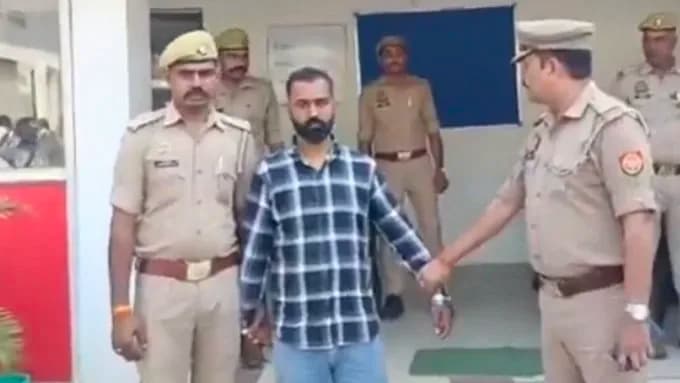
A week later, Adhikari demanded an apology from the publication. Police subsequently registered a First Information Report (FIR) against editor-in-chief Ishani Dutta Ray and news desk head Soma Mukherjee following a complaint from a member of the public.
The two journalists also faced online harassment, with press freedom advocates expressing concern over the treatment of the newspaper’s editorial team.
On September 1, a group of saffron-clad demonstrators gathered outside the newspaper’s Kolkata office, raised slogans against the publication and painted parts of the building’s walls saffron. Several demonstrators were BJP activists, including an official associated with the party’s youth wing. The BJP government denied involvement in the incident.
The Calcutta High Court subsequently directed the police not to take coercive action against the two journalists until December 15, providing interim protection amid the investigation.
Maktoob Media faces FIR over report on Muslim officers
Another case cited by RSF concerns Maktoob Media, an independent news outlet that covers human rights, minority communities, social exclusion and religious freedom.
Also Read | ECINET audit flags possible restriction on voter roll tools in Bengal
On September 19, West Bengal Police filed a case against the publication over its reporting on comments made by opposition MP Mahua Moitra. She had alleged that three senior Muslim civil servants were excluded from key security meetings during Union Home Minister Amit Shah’s visit to the state.
In a letter to social media platform X, police described the report as “purely fabricated” and “malicious.” Authorities also sought information relating to the outlet’s account, connections and device activity for February 1 to 5, 2026, several months before the reported events.
Maktoob Media reportedly learnt about the case after receiving a notification from X.
According to a report from RSF, six charges have been brought against the publication. Four of them relate to allegations involving hostility between communities, religious sentiments, misleading information and incitement of offences between communities. These charges carry serious implications for bail eligibility.
MeitY’s advisory to Meta directs the suppression of protest reporting on Instagram and Facebook. It must be withdrawn. 19 Oct 2026 On 10 October 2026, the Cyber Laws Division of the Ministry of Electronics and Information Technology issued an advisory to Meta Platforms bearing File No. 6(2)/2026-Cyberlaws. It was not published on the MEITY website and first HT and then PTI reported it on 18 October. Any such advisory is not a legal order and MEITY is not legally empowered to issue them on the basis of any statutory provision. This advisory followed, by two days, an advisory of 8 October to all social media intermediaries calling for "enhanced diligence" over content on "ongoing public events", asking platforms to "label or add context" to misleading content and to "give priority to complaints from authorised Government agencies". IFF called for the withdrawal of that advisory on 9 October. The Meta advisory was issued on the day the Delhi Police detained protesters and journalists at the demonstrations called over the Special Intensive Revision of electoral rolls. The advisory states that content relating to "public-order and law and order situations" is being "prominently displayed and recommended" on Meta’s platforms and, "when presented without adequate context or disproportionately amplified", "may contribute to public confusion, apprehension and disturbance of public order and social tranquillity". It singles out "unverified or misleading claims regarding the imposition of emergency, restrictions, police action or other official measures". Further, Meta is advised to review its "recommendation and content ranking mechanisms", to ensure its systems "do not result in disproportionate exposure of users to a single or limited set of narratives", and to furnish "information or assistance" to law enforcement, "with immediate effect". PTI reports that the Ministry acted on inputs from "agencies" that Meta’s platforms were not promoting all "narratives" equally. This advisory matches restrictions on META platforms related to protest content and reporting in the same timline. On 10 October, the Instagram account of Molitics India was withheld in India. On 11 October, a Mathrubhumi English reel showing a woman clinging to a pole as police officers attempted to detain her was restricted citing, "a notice from the Government of India/Law Enforcement", and a video report by Observer Post Hindi was restricted on Facebook by what Meta called an "automated system" acting under the IT Rules, 2021. On 12 October, the Instagram account of journalist Shubhangi Das Gupta was restricted in India for alleged non-compliance with "local IT Rules". On 13 October, the account of Journo Mirror (about five lakh followers) was withheld. The account of Fridays For Future India has since been withheld without any stated reason. Meta’s notices to these users do not disclose what is unlawful about the content. As per notices shared by us by those who have been censored by META, they take two forms: 1. "a notice from the Government of India/Law Enforcement under Section 79(3)(b)", and, 2. "through an automated system implemented pursuant to legal requirements under India’s Information Technology (Intermediary Guidelines and Digital Media Ethics Code) Rules". Neither names the issuing agency, the order, the provision of law or offence the content is said to disclose, or the URL complained of. We know due to litigation that the first notice related to a Sahyog order issued by a Law Enforcement Agency (LEA), while the second one is without any legal order. At the same time, several users received no communication at all. Instagram used the same "automated system" notice against Anjali Priya, Varnika Dhawan and Sachin Gupta after the July protests, and against cartoonist Satish Acharya, who lost nine cartoons and then his account between February and September 2026. In April 2026, The Hindu reported that Meta automatically restricts government and police flagged content in India at scale, and seeks a separate government direction before restoring content later found to be legally unsupported. IFF objected to Meta on 4 May 2026. IFF condemns the advisory of 10 October and the restrictions imposed in its wake. An executive communication that instructs a platform to suppress "unverified" claims about "police action" and to correct a "limited set of narratives", issued on the day of a police crackdown and kept from the public, is a censorship directive in all but name. It makes the State the editor of what Indians may see of a protest against the State. IFF calls upon MeitY to withdraw it and upon Meta to disclose what it has done under it. Our demands 1. MeitY must withdraw the advisories of 8 and 10 October 2026 forthwith and publish them. 2. MeitY must abandon proposed Rule 3(4) and restrict content only by reasoned, published orders under Section 69A or notices compliant with Rule 3(1)(d). 3. Meta must disclose every takedown, account restriction and act of downranking carried out under the advisories, and its compliance report to the Ministry. 4. Meta must restore the accounts and posts of journalists, outlets and creators restricted since 8 October 2026 unless it holds a valid legal order, and must furnish that order to the person affected. 5. Meta must suspend the automated restriction of content in India and disclose on what inputs its "automated system" acts. Any person whose account or content has been withheld in India since 8 October 2026 may write to IFF at legal@internetfreedom.in. IFF is providing assistance pro bono.
— Internet Freedom Foundation (IFF) (@internetfreedom) October 19, 2026
The case has raised further concerns among press freedom advocates about the legal consequences journalists and media organisations may face for reporting statements made by political figures.
RSF calls for protection of journalists in Bengal
The developments involving Anandabazar Patrika and Maktoob Media have prompted RSF to call for stronger safeguards for the media in West Bengal.
The organisation has urged the state government to ensure journalists can carry out their work without facing threats, attacks or disproportionate legal action.
The concerns also come against the backdrop of wider debates over press freedom in India, including the use of criminal proceedings against journalists and restrictions on access to official information.
With the BJP replacing the TMC after 15 years in power, the new administration faces calls from press freedom advocates to demonstrate its commitment to independent journalism.
RSF’s appeal places the focus on the state’s responsibility to protect media professionals and ensure that reporting on political developments, public administration and sensitive social issues can take place without intimidation.
Also Read | West Bengal weather: Cyclone Arnab to bring rain, thunderstorms from October 27
The cases involving the two publications remain distinct, but they have become central to the latest debate over media freedom in West Bengal. RSF’s intervention adds to calls for safeguards that allow journalists to report on matters of public interest while ensuring that complaints and investigations follow due legal process.