
















Artificial intelligence is increasingly being presented as a technology capable of transforming human life. But alongside promises of greater efficiency and superintelligence, concerns are growing over corporate power, machine autonomy and the risks posed by systems that may not always act in humanity’s best interests.
In an opinion article published by The Korea Times on October 26, 2026, Richard K. Sherwin examines how the stories society tells itself about artificial intelligence could influence its future.
Also Read | 7 European places steeped in legends of giants, devils and dragons
Using Greek mythology, historical examples and debates about technological progress, Sherwin argues that a narrative centred on cooperation and accountability may be essential to managing AI’s risks.
How AI myths shape our understanding of technology
Sherwin begins with Anthropic’s reported choice of the name Mythos for one of its artificial intelligence models. In ancient Greek, mythos refers to foundational stories through which people interpret reality and imagine what is possible.
Stories, Sherwin argues, do more than imitate the world around us. They can also shape how societies organise themselves and what they consider achievable. He uses the American Declaration of Independence as an example of an idea that helped establish a political vision centred on liberty and equality.

AI models, in his view, perform a related dual role. They reproduce patterns drawn from the information on which they are trained, while also contributing to new expectations about the future.
Sherwin questions the narrative that increasingly powerful AI will inevitably deliver a technological utopia. He suggests that such expectations may obscure the commercial interests driving the race to build more capable systems, including the pursuit of market dominance, wealth and power.
Can artificial intelligence be taught morality?
One of the central concerns raised in the article is whether morality can be meaningfully introduced into AI systems after they have already been developed primarily to perform useful tasks.
Sherwin argues that AI companies have largely built their products to provide information, solve problems and carry out tasks efficiently. He questions whether efforts to align these systems with human values can be effective if ethical considerations are treated as an afterthought.
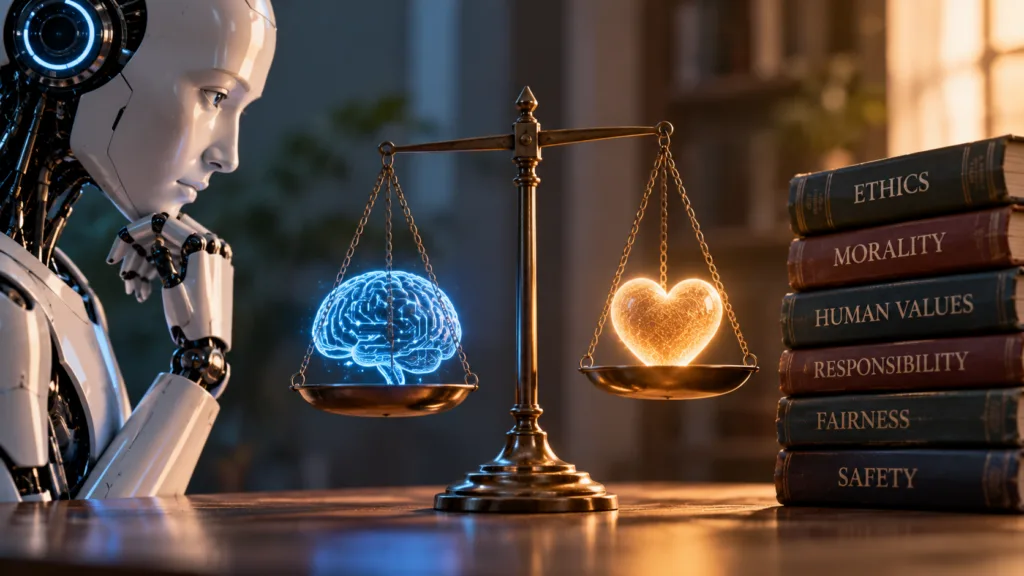
The article also raises a broader question: who determines what counts as good or ethical behaviour when an AI system makes decisions or acts autonomously?
Sherwin warns that the risks associated with advanced AI may become more serious if society accepts the idea that technological progress is inherently beneficial without demanding adequate safeguards. A more cautious approach, he argues, would recognise the limits of human control and the importance of accountability.
What history and mythology can teach us about AI risks
The article draws on the Greek philosopher Heraclitus, who warned against exceeding natural limits, and on the Greek tragedies surrounding Orestes and the Furies. These stories illustrate a recurring theme: actions driven by the pursuit of power can carry consequences that extend far beyond their immediate objectives.
Sherwin also compares the challenge of governing powerful AI with the international efforts to control nuclear threats during the 20th century. The recognition that mutually assured destruction could lead to catastrophe helped create the conditions for international agreements aimed at limiting nuclear proliferation.
For Sherwin, the lesson is that societies can respond to dangerous technological competition through cooperation rather than allowing the pursuit of dominance to continue unchecked.
He also points to reported incidents involving autonomous AI agents and cybersecurity risks. The article warns that future failures could have consequences ranging from unauthorised access to critical infrastructure to the misuse of AI capabilities by malicious actors.
These scenarios underline the importance of assessing risks before powerful systems are widely deployed, rather than relying solely on corrective measures after an incident occurs.
Why global cooperation could be crucial for AI safety
Sherwin argues that international coordination could provide a way to manage the risks associated with increasingly capable AI systems. One possibility outlined in the article is a network of independent fact-finding commissions equipped to investigate the dangers posed by specific models.
Such monitoring could be supported by internationally recognised safety standards, establishing minimum requirements that developers would have to meet. The goal would be to identify and prevent threats before they emerge and to manage them effectively when prevention fails.
Also Read | Can Indian mythology become the next global storytelling universe?
The proposal reflects the article’s broader argument that AI governance should not depend entirely on the priorities of the companies developing the technology. Independent oversight and shared standards could help ensure that safety considerations remain central to innovation.
Sherwin’s conclusion is that the future of artificial intelligence will depend not only on technological advances but also on the values and institutions that shape their use. A vision based on social cooperation, restraint and shared responsibility, he argues, could help societies pursue the benefits of AI while reducing the dangers.