










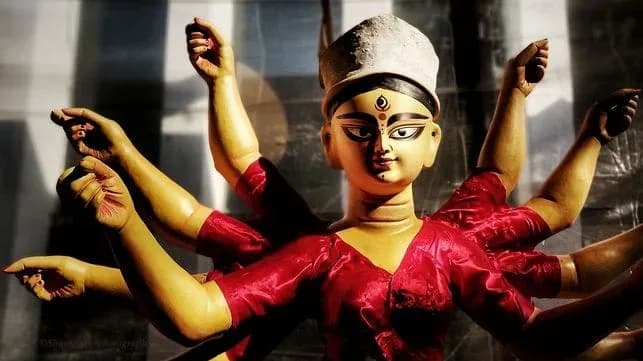
For Kolkata, Durga Puja is much more than a five-day religious festival. Every autumn, the city transforms into a vast cultural space where neighbourhoods, streets and public squares become places of worship, art and storytelling. Behind the lights, elaborate pandals and crowds of visitors lies a history that stretches across centuries.
The festival has changed considerably over time. What was once largely associated with the homes of wealthy families gradually moved into public spaces, allowing communities to participate in celebrations that were once largely private affairs. Today, Kolkata’s Durga Puja reflects not only religious traditions but also the city’s social history, artistic imagination and collective memory.
From aristocratic homes to public celebrations
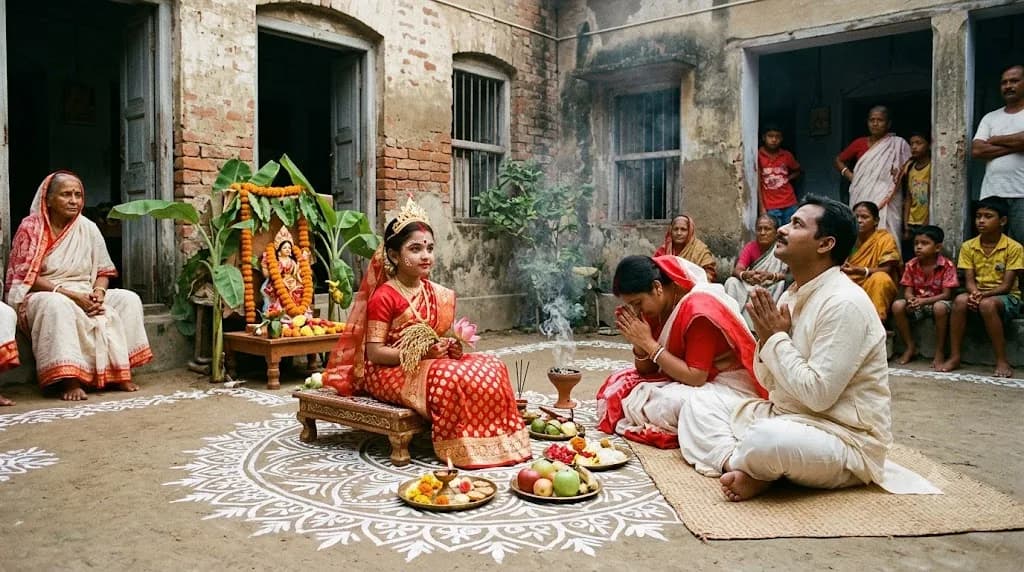
For a long period, grand Durga Puja celebrations in Bengal were associated with zamindar and aristocratic households. These family pujas were closely connected with wealth, social status and tradition, with elaborate rituals taking place within the boundaries of private residences.
The emergence of community-based celebrations changed that structure. The Barowari and later Sarbojanin formats brought the festival into public spaces and opened participation to a much wider section of society.
The origins of the Barowari tradition are commonly associated with Guptipara in Hooghly, where a group of twelve friends is believed to have organised a community Puja in the 18th century. The idea gradually spread, eventually influencing the way Durga Puja was celebrated across Bengal.
The shift was significant because it transformed Durga Puja from a largely household-centred celebration into a collective public event.
Kolkata turns Puja into a cultural canvas
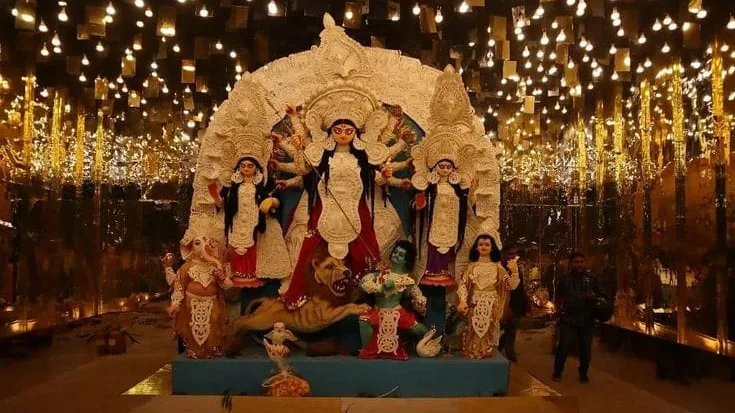
As community Pujas became increasingly popular, the pandal itself evolved. It was no longer simply a temporary structure created to house the idol. It became a space for artistic expression.
Kolkata’s puja committees began experimenting with architecture, sculpture, painting, craft and design. Traditional materials were combined with modern artistic techniques, while themes began drawing inspiration from Bengal’s history, literature, cinema, folk culture and social life.
This transformation has made pandal-hopping an important part of the city’s festive culture. Visitors do not simply move from one shrine to another; they travel through different stories and visual interpretations of Bengal and the wider world.
Also Read | Why Goddess Lakshmi entered the ocean after Durvasa’s curse
The city’s history lives inside its Puja
One of the most interesting aspects of Kolkata’s Durga Puja is the way historical memory appears within contemporary celebrations.
Themes often bring forgotten people, artistic traditions, old neighbourhoods and historical events back into public attention. A pandal can recreate an architectural tradition, showcase an old craft or use an installation to tell visitors about a chapter of Bengal’s past.
Recent exhibitions and cultural projects have similarly traced the evolution of Durga Puja through manuscripts, old printed material, artwork and archival records. The Asiatic Society’s 2026 exhibition, for instance, explores the festival’s development from early religious traditions and household celebrations to Barowari and Sarbojanin Pujas.
Pandal-making becomes public storytelling
The contemporary pandal has therefore become a form of public storytelling. Unlike a museum, it does not require visitors to enter a formal cultural institution to encounter history or art. The stories appear in the middle of neighbourhoods, alongside roads and within spaces that people pass through every day.
This accessibility is an important part of Kolkata’s Puja culture. A visitor who comes to see an idol may also encounter a story about a forgotten community, an artist, a historical tradition or an environmental concern.
In this sense, Durga Puja allows history to be experienced rather than simply read.
A festival that continues to evolve
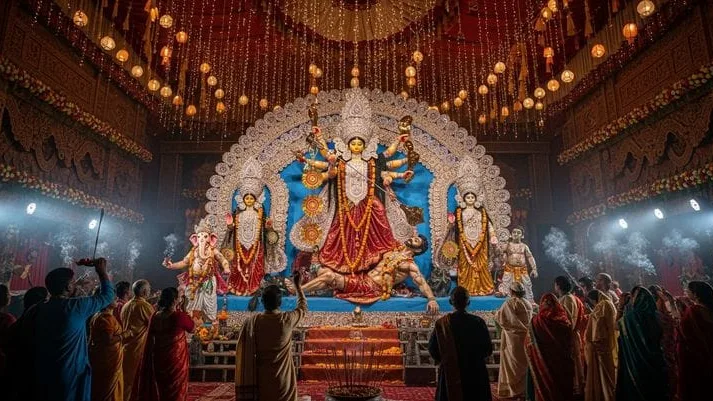
Kolkata’s Durga Puja has continued to change with the city itself. The festival has retained its religious core while becoming increasingly connected with art, design, heritage and public participation.
The journey from private household celebrations to large community Pujas also explains why the festival occupies such a distinctive place in Kolkata’s cultural life. It belongs to the city as much as it belongs to individual neighbourhoods and families.
Every year, new themes and new artistic interpretations add another layer to that history. The pandals may disappear after the festival, but the stories they tell become part of Kolkata’s collective memory.
That is perhaps what makes Durga Puja in Kolkata so distinctive: the festival does not simply preserve history. It continually creates new ways for the public to encounter, interpret and remember it.