









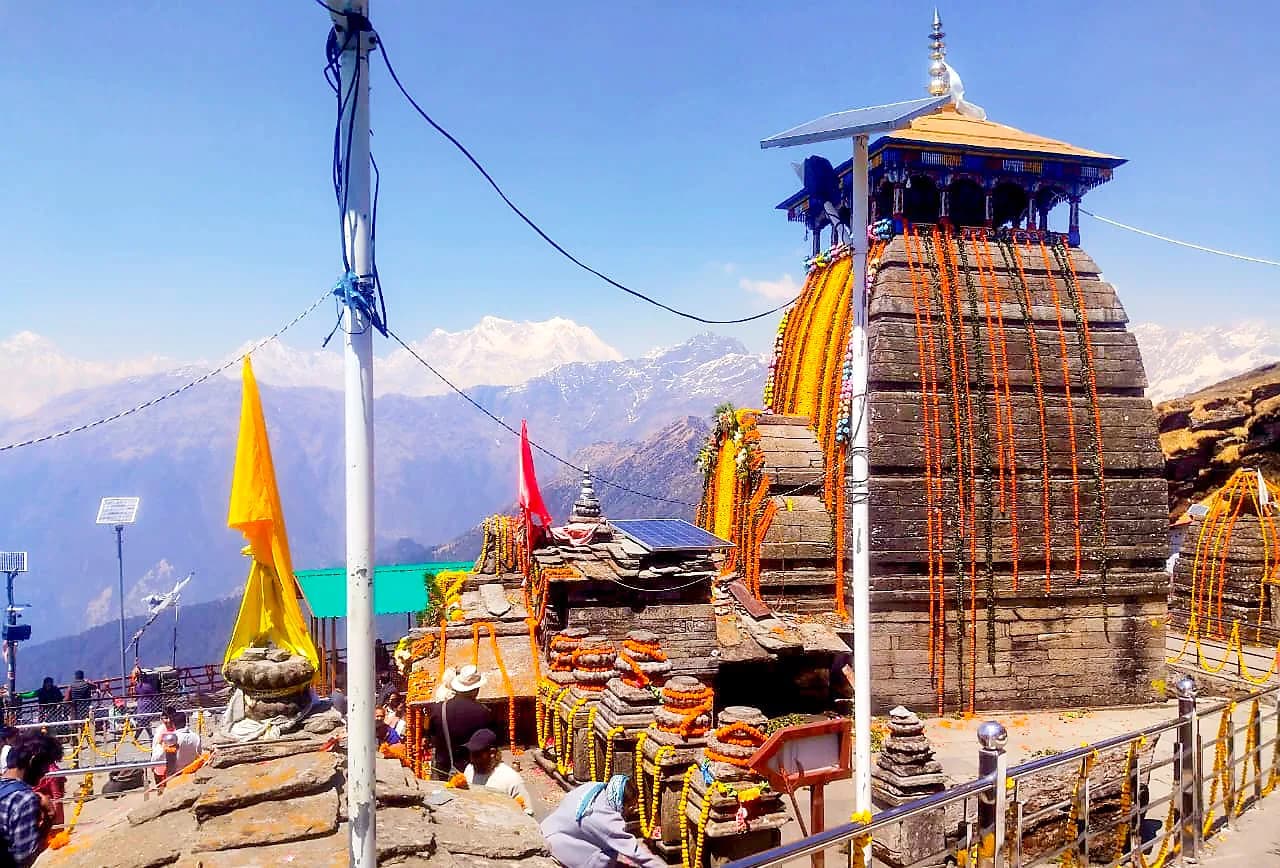
Located at a height of 3,680 metres (12,073 feet) in the Garhwal Himalayas, Tungnath is known as the highest Shiva temple in the world.
This alone brings visitors from all over the world, be it for trekking, photography or pilgrimage. However, giving it the status of a geographical superlative does not reflect its true importance.
If you do Pancha Kedar, then Tungnath is not just a cloud-sculpted temple. It is a sacred place where Lord Shiva’s arms are thought to have emerged after he left the earth when he was running away from the Pandavas.
Kedarnath is the burden that one should carry, and Tungnath is the responsibility of action.
ALSO READ| Pancha Kedar–Part 1: Why did Lord Shiva hide from the Pandavas?
The story begins where the legend of Kedarnath leaves off. The Pandavas went on a pilgrimage to the Himalayas to find Lord Shiva to get forgiveness for the tremendous destruction they had seen and also caused during the Kurukshetra war. Until they learned humility, Shiva could not grant forgiveness; He disguised Himself as a magnificent bull. When Bhima saw that the deity was disguised in the form of a bull, he tried to grab the deity, but the bull disappeared below the ground. Then, the various parts of Shiva appeared at five places in the Garhwal Himalayas.
Then, at Kedarnath, emerged the hump. At Tungnath, the arms manifested from the mountainside. Why the arms?
Ancient Indian mythology rarely chooses body parts at random. All symbols have a message. The arms are the instruments of action. They construct, defend, love, work and when needed, they fight. All of man’s actions are initiated by his will and translated by his hands. The word “Karma” does not just mean “destiny” in Sanskrit. It literally means action. The arms then are the fruit of one’s work or action and are thus visible.
Maybe the figure of Shiva at the Tungnath serves as a reminder to the human race of one of the main teachings of the Bhagavad Gita: it is not action that binds humans, but attachment to action’s results.
It was because Dharma called for it that the Pandavas fought. But they were still under the burden of the effects of war, as all actions, even if they are justified, impact the heart. Shiva shows His arms at Tungnath and seems to be saying here that the redemption is not to cease action but to cleanse the motive of action.
Why is it called Tungnath?
The name Tungnath itself offers another clue. Derived from two Sanskrit words, Tunga, meaning ‘lofty’ or ‘elevated,’ and Nath, meaning ‘Lord’, the name may be translated as ‘The Lord of the Highest Peaks.’ Standing amidst alpine meadows with uninterrupted views of the Chaukhamba, Nanda Devi, Trishul and Kedarnath mountain ranges.
Unlike many Himalayan pilgrimages requiring days of difficult trekking, Tungnath can be reached by a relatively short but steep trail beginning at Chopta, often called the ‘Mini
Switzerland of India.’ The walk covers barely four kilometres, and dense forests of oak, deodar and rhododendron gradually give way to rolling alpine grasslands known as bugyals.
Himalayan birds fill the air with song.
Only mountains.
Only silence.
Only the rhythmic sound of footsteps against ancient stone pathways.
ALSO READ| Pancha Kedar–Part 2: Kedarnath, where Lord Shiva’s hump emerged and time stands still
For centuries, sages have regarded such silence as one of the Himalayas’ greatest teachers. In cities, the mind constantly reacts to noise, movement and distraction, but in the mountains, thought itself begins to slow. Perhaps that is why Shiva chose these heights.
How old is Tungnath?
The present temple is believed to be over a thousand years old, though local traditions attribute its earliest foundation to the Pandavas themselves.
Like Kedarnath, the existing stone structure is often associated with the revival of Himalayan pilgrimage routes during the time of Adi Shankaracharya in the eighth century.
Beyond Tungnath lies another sacred destination, Chandrashila, a summit rising to nearly 4,000 metres. The short climb from the temple rewards pilgrims with one of the most breathtaking panoramic views in the Indian Himalayas.
Yet Chandrashila is more than a viewpoint. According to tradition, Lord Rama meditated here after defeating Ravana, seeking purification for the act of killing a Brahmin king. Another legend associates the peak with Chandra, the Moon God, who performed penance after being cursed by Sage Daksha.
These stories reveal an intriguing pattern. Even the greatest among the Indian epics’ heroes, like the Pandavas after Kurukshetra or Rama after Lanka, perform penance after performing their duty. Victory is never deemed good enough. All good deeds require contemplation.
This is a common theme that is missed by modern readers.
Indian mythology celebrates courage, but it also celebrates introspection. Power without humility is incomplete. Action without self-examination is dangerous.
Throughout Indian philosophy, the hand occupies a sacred place. The ancient morning prayer ‘Karagre Vasate Lakshmi’ begins by reminding us that prosperity, knowledge and divine power reside within our own hands.
ALSO READ| Why is Shiva worshipped as a Lingam while other gods have idols?
Tungnath is also the time of the seasons, as in the other Pancha Kedar temples. The temple is shut in winter when the snow is heavy, and the worship of the deity is symbolic at Makku Math.
These days, a lot of people visit Tungnath because they’ve seen snow-covered paths or some enchanting sunrise images from Chandrashila on social media. Some go for trekking, and others are for adventure.
However, nearly everyone walks away with a surprise. Tungnath seems serene and does not invite the hasty tourist. The mountains have their rhythms, and slowly, almost imperceptibly, the visitor starts on a more gentle pace to walk, breathe, and think.
Maybe this is the advantage that Shiva has bestowed upon us.