















Binance, the world’s biggest cryptocurrency exchange, has suffered a theft of about $6.3 billion in what blockchain analysts describe as the largest cryptocurrency heist on record.
The bulk of the money was moved in around 20 minutes on Thursday, according to blockchain records. The attack has raised questions about how hackers gained access.
One laptop, $6.3 billion gone? Inside the massive Binance crypto breach https://t.co/ieBOd5cGwZ
— Sarwesh Sri Bardhan (@sri_sarwesh) October 30, 2026
Also Read | What is Dahiya Doctrine? 5 key facts about Israel’s strategy of disproportionate force
The breach and how the heist unfolded

The breach was not simply a case of hackers guessing a password and accessing an ordinary user account. TRM Labs said the attackers compromised Binance’s “signing infrastructure”, the system used to authorise transactions before a wallet releases funds.
That allowed them to issue instructions that emptied affected wallets. Binance initially suspected a compromised laptop, but later said its investigation had uncovered additional “points of breach”. It has not publicly detailed those entry points.
The affected wallets included an internet-connected “hot wallet”, which exchanges use to process transactions and move assets quickly.
The attackers appear to have interfered with the approval system behind the wallet. They may not have needed to steal the wallet’s private key itself.
Hong Kong-based crypto lawyer Joshua Chu explained the distinction to Reuters, “the attacker may not have stolen the vault key, they may have hijacked the system that tells the vault to release money.”
After the coins left Binance-controlled wallets, the attackers tried to move them beyond the reach of the exchange and other industry players.
Some stablecoins, including Tether’s USDT and Circle’s USDC, are issued by companies that can freeze tokens linked to suspicious activity. Bitcoin and ether do not have a central issuer with the same power.
Tether, Circle, Ripple and World Liberty Financial had frozen roughly half of the stolen assets. Tether said it froze nearly $1.57 billion, while Circle froze more than $800 million.
A freeze does not automatically return the money to Binance. It mainly stops the affected tokens from being moved freely.
Binance hack: $6.3B out in 40 minutes. $3B frozen in under an hour. Entry point was one employee laptop, not a private key. The biggest exchange in the world, and it still came down to one human. Full story in the video. #Binance #BinanceHack #CryptoWala https://t.co/1ANkfTsYZf
— CryptoWala (@cryptowalax) October 30, 2026
The suspected North Korean connection
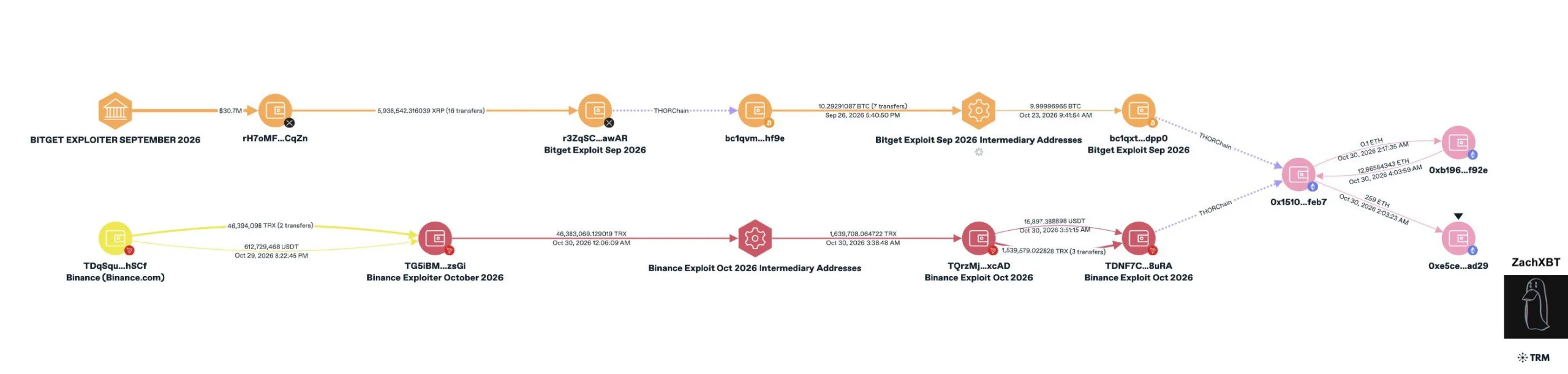
TRM Labs attributed the theft to TraderTraitor, which it described as a North Korean hacking unit, saying it made the assessment with “high confidence”.
Chainalysis also said the attack was likely carried out by the same group.
The firms cited similarities with previous North Korea-linked thefts, including the 2025 Bybit hack. Binance, however, said it was working with law enforcement partners to identify those responsible.
North Korea has routinely denied involvement in cyberattacks.
NEW: The world’s largest crypto exchange Binance experienced a $6.3 billion hack, making it the largest in history. 👀 A statement was issued saying that user funds are safe and over $3 billion in assets have been frozen. https://t.co/41nny1G9QM
— Bitcoin Magazine (@BitcoinMagazine) October 30, 2026
Also Read | Serbia’s student-backed movement wins majority, but governing will test its mettle
Who picks up the hefty bill?
The incident has also put the spotlight on crypto insurance. Exchanges and digital-asset custodians can buy specialised policies covering theft, cyberattacks, technology failures and legal claims.
But cover is not automatic or unlimited. Policies have limits, deductibles and exclusions.
Standard cyber insurance may pay for investigations, customer notifications and legal costs without covering the cryptocurrency itself, unless specific digital-asset protection is included.
Poor management of private keys can also affect whether an insurer pays a claim.
Binance has said it will cover the losses and that customer funds are safe. The company had set aside about $6.34 billion in company funds to cover the theft.
It also operates the Secure Asset Fund for Users, or SAFU, an emergency reserve worth roughly $1 billion in bitcoin as of 2026, according to Binance’s website.
Co-CEO Richard Teng said losses would be covered by the fund and company resources. Binance has not publicly confirmed the extent of its insurance coverage.
The recovery process remains separate from the question of who will ultimately bear the loss. The exchange says it will reimburse users, while investigators and industry partners continue trying to trace and freeze the stolen coins.