














The Kurukshetra war was over. The shells of conches had fallen silent, the dust of battle had settled, and the throne of Hastinapura had returned to the Pandavas. Adharma had been conquered, justice had been re-established, and the rightful rulers had been found. But the Mahabharata differs from most epics in this way: it will not culminate in a celebration. Rather, it poses the question: Can success overcome the tragedy of war?
Yudhishthira’s response was NO.
ALSO READ| Why is Shiva worshipped as a Lingam while other gods have idols?
The eldest of the Pandavas was chosen as king, but it was a crown that was too heavy to bear. Upon it was a jewel for every one of those who had died. Not strangers but relatives, teachers, friends and cousins had been drained from the battlefield of Kurukshetra. The grandsire Bhishma, who used to carry the princes on his shoulder, lay pierced by countless arrows.
Their great guru Dronacharya was dead. Their own elder brother, Karna, whom they had known too late, had been killed. Even the sons of Pandavas were killed at the end of the war. Victory had been won at a price no king could ever return.
Krishna repeatedly reminded Yudhishthira that the war had become inevitable. It was fought not for ambition but to restore justice after years of deceit and humiliation. Yet even Krishna never suggested that righteousness erased sorrow.
Dharma may require difficult choices, but those choices still leave scars upon the human heart.
Why were the Pandavas looking for Lord Shiva?
The Pandavas were in remorse and went to the sage for advice. What possible way could they make up for the huge destruction they had witnessed? They were stunned by the response they got. They were informed that Lord Shiva, the great ascetic and destroyer of ignorance, alone had the power to release them from the shackles of their Karmas. Mahadeva Himself is the one who could grant forgiveness for the bloodshed of Kurukshetra.
However, Shiva is not like any other god in Hindu mythology. He’s very compassionate, but not predictable. Whereas Vishnu comes down to Earth again and again when there is no righteousness in the world, Shiva withdraws from the affairs of men.
The Adi Yogi is the god of silence, meditation and detachment. He watches the rise and fall of kingdoms with the same calm gaze. He blesses kings and beggars alike, yet He remains untouched by power, wealth or ambition.
Then, as the Pandavas were looking for Shiva, he made an unusual move. He decided to go away. But why would the Lord deny devout believers who earnestly came to him asking for forgiveness? The solution is in Shiva’s very nature.
Forgiveness is not just God’s gift to us. It’s a culmination of inner transformation. The Pandavas had strived for justice, but they were still full of pride, sadness and the silent burden of violence. They were not yet humble enough to be blessed by Shiva.
So, leaving behind the holy city of Kashi, Shiva started his journey northward into the Himalayas, which had always been His favourite place to reside as it was the land of snow. The mountains were his refuge: long before there were kingdoms, long before human beings named rivers and valleys. The Pandavas relentlessly chased Him, going through forests, rivers and steep paths in the mountains. Their tour was a journey without parallel to that of any royal enterprise. There were no armies with them; there were no trumpets that would announce their coming. The once powerful kings strolled as common pilgrims along precipices soaring high beyond all human accomplishment.
Perhaps that was Shiva’s first lesson.
The Himalayas have always possessed a unique place in Indian spirituality. They are not merely mountains but symbols of permanence in a world of constant change. Empires rise and disappear, rivers alter their courses, generations come and go, yet the Himalayas continue to stand in silent meditation. For sages, the mountains represented the ideal state of consciousness, still, unwavering and detached from worldly turmoil.
What is Guptkashi?
It was here, according to ancient tradition, that Shiva decided to conceal Himself. As the Pandavas approached the region known today as Guptkashi, literally, the ‘Hidden Kashi ’, Shiva assumed the form of a magnificent bull and quietly mingled among a herd grazing peacefully in the alpine meadows. The choice of a bull was no accident. Nandi, Shiva’s divine vehicle, has always symbolised righteousness, patience and disciplined strength. By taking the form of a bull, Shiva was reminding the Pandavas that true Dharma cannot be established merely through victory in battle. It must also be sustained through humility and compassion.
The Pandavas searched desperately among the herd, sensing that the Lord was somewhere nearby. It was Bhima, the strongest of the five brothers, who devised an ingenious plan. Stretching his enormous frame across a narrow mountain pass, he allowed the cattle to pass beneath him one by one. Every ordinary bull quietly crossed the path. Only one animal behaved strangely. The mysterious bull suddenly began to sink into the earth as though the mountain itself had opened to receive Him. Realising that this was no ordinary creature, Bhima leapt forward and seized the bull by its hindquarters. But before he could hold on, Shiva vanished beneath the ground.
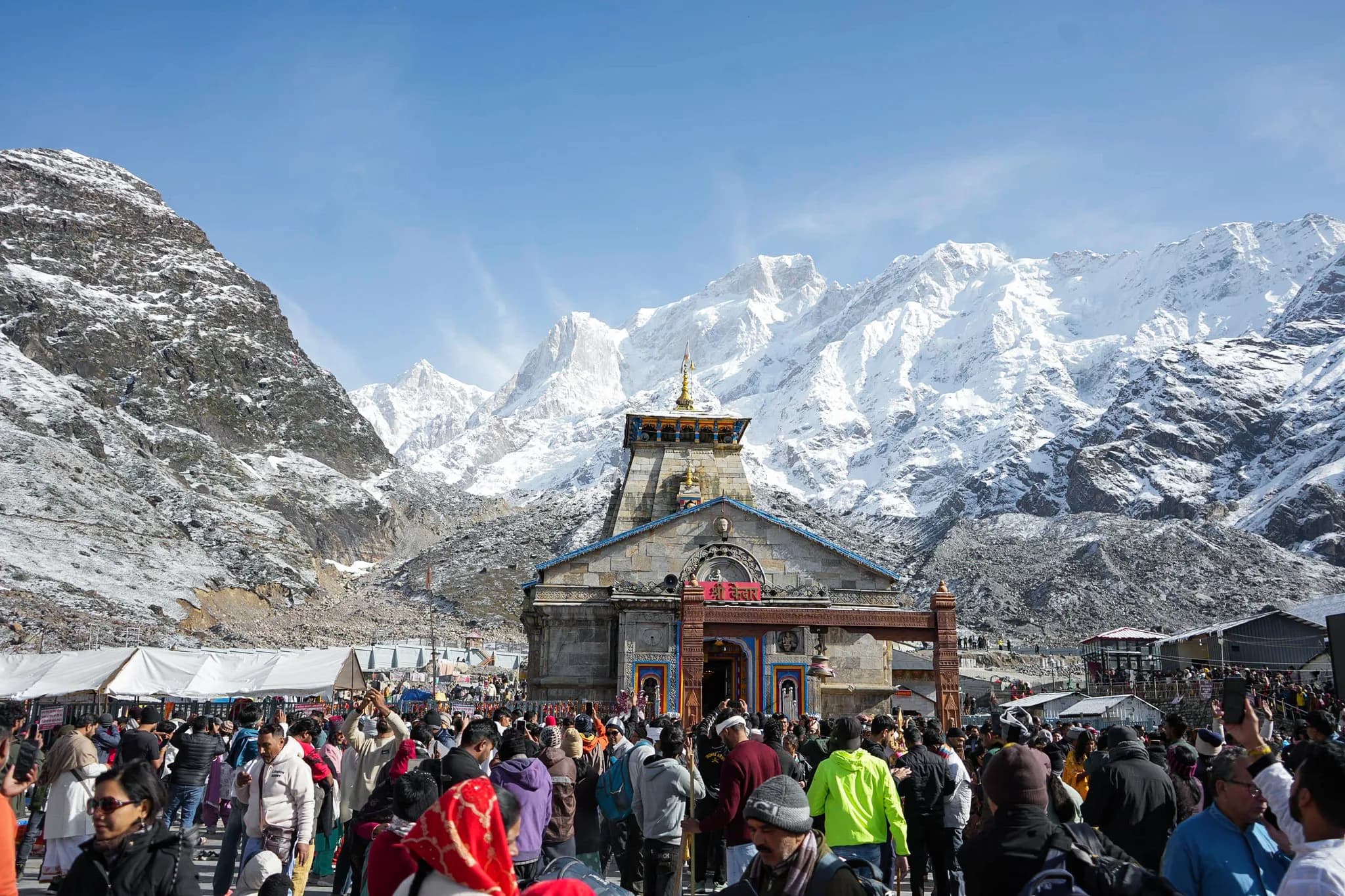
This wasn’t the end of the encounter because Shiva just vanished. Rather, it gave rise to one of the holiest pilgrimages in the Himalayas. The legend goes that the various parts of Shiva’s divinely endowed body appeared at five different places in the Garhwal Himalayas. The hump of a bull was seen at Kedarnath. The arms were found at Tungnath. God appeared in Rudranath as God’s face. Madhyamaheshwar was the place where the navel and body of Shiva appeared, and Kalpeshwar was the spot where Shiva’s matted locks appeared. All these five sacred shrines were known together as the Pancha.
Kedar, the five holy manifestations of Lord Shiva. To read this merely as a miraculous event is to miss the deeper beauty of the story. Indian mythology rarely speaks only through literal events. It speaks through symbols.
Why did Shiva appear in fragments rather than revealing His complete form?
Perhaps because no human being ever comprehends the infinite in a single moment.
Spiritual understanding arrives gradually. One seeker discovers strength. Another discovers compassion. Someone else discovers silence. Each glimpse reveals only one aspect of an immeasurable reality.
What do these five Kedars symbolise?
The five Kedars may therefore be understood as five stages in the journey towards self-realisation.
Kedarnath, where the hump appeared, symbolises endurance, the ability to carry the burdens of life without surrendering to despair.
Tungnath, associated with Shiva’s arms, reminds us that action must always serve righteousness rather than ego.
Rudranath, where His face manifested, represents truth, urging the seeker to confront the deepest realities of one’s own mind.
Madhyamaheshwar, linked with the navel, signifies the source of life and the balance that sustains creation.
Kalpeshwar, where the divine locks emerged, points towards renunciation, meditation and the infinite flow of consciousness.
The Pandavas were able to get the blessings of Shiva after sincerely visiting all the five sacred places. Even then, there was more to the blessing than forgiveness. It was transformation. By the time they arrived at its end, the pilgrimage had already transformed them.
Perhaps the most deep-rooted message that is embedded in the legend of the Pancha Kedars.