















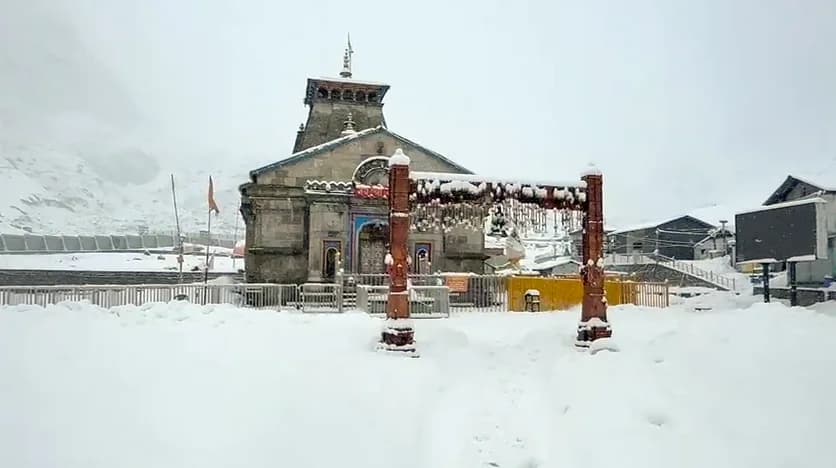
Then, at an altitude of nearly 3,583 metres (11,755 feet), surrounded by snow-clad Himalayan peaks and nourished by the icy waters of the Mandakini River, stands one of India’s most revered temples, Kedarnath. Every year, for barely six months, thousands of pilgrims undertake the arduous journey to this sacred shrine, walking through steep mountain trails, unpredictable weather and thin mountain air.
However, not many people know that Kedarnath is not just one of the 12 Jyotirlingas of Lord Shiva. It is also the first out of the sacred abodes of the Pancha Kedar, where it is believed that Lord Shiva appeared to the Pandavas after the Mahabharata war.
The story starts not at Kedarnath, but on the blood-stained plains of Kurukshetra. The Pandavas won the battle after eighteen days with a test of their might, but their victory did not bring them any respite. Their own family members, teachers, friends and many innocent soldiers had been lost in the war. They were in a state of guilt and wanted to rid themselves of the sin of war by seeking blessings from Lord Shiva.
ALSO READ| Pancha Kedar–Part 1: Why did Lord Shiva hide from the Pandavas?
However, Shiva was not ready to meet them straight away, so he went to the Garhwal Himalayas and took the shape of a great bull. Bhima then saw that he had been deceived by a god and tried to capture him, and the bull went underground.
According to the legend, different parts of Shiva’s body emerged at five separate locations. At Kedarnath, the hump of the divine bull surfaced from the ground, making it the most important shrine of the Pancha Kedar pilgrimage.
Another miraculous episode from Indian mythology?
Like most legends, there are deeper symbolic meanings, and this is no exception. The hump of a bull is more than a physical attribute. It symbolises strength, endurance and the ability to carry great loads. In whole Indian civilisation, the bull is a symbol of Dharma, steadfastness, patience and responsibility. By showing His hump at Kedarnath,
Shiva appears to be teaching the human race that spiritual development starts when one learns to bear the weight of our lives without rancour and hostility. Perhaps that’s why Kedarnath has always been a place of atonement and never a place of celebration.
Whereas the temples in the city require little effort, Kedarnath requires effort. As is still the case today, the trek to the shrine is a difficult journey up the mountain from Gaurikund. A pilgrim climbs through thick forests, waterfalls, rocky roads and high-altitude valleys until finally he reaches the temple.
Each step is an integral part of the worship. The Himalayas are unique in their ability to take away earthly identities. A rich man, a scholar, a labourer and a saint go on the same road, inhale the same air of the mountains, and are equally exhausted from the physical effort.
Before Shiva, everyone becomes simply a pilgrim
The location of Kedarnath is itself extraordinary. The temple stands against the dramatic backdrop of the towering Kedarnath Peak, which rises to nearly 6,940 metres. Glaciers surround the valley, and the Mandakini River flows nearby, carrying icy waters born from Himalayan snowfields. Ancient Indian sages did not choose such places by accident.
Mountains have always symbolised stability and transcendence. They rise above the noise of ordinary life.
For Shiva, the eternal yogi immersed in meditation, the Himalayas were not merely a residence but an extension of His own consciousness.
Notably, tradition attributes the earliest shrine to the Pandavas themselves, who are believed to have built a simple temple after receiving Shiva’s blessings.
Historians suggest that the present stone structure was probably constructed between the 8th and 12th centuries CE, with many associating its revival and restoration with Adi Shankaracharya, the great philosopher who travelled across India re-establishing centres of Hindu learning and pilgrimage.
Near the temple lies a memorial traditionally believed to mark the place where Shankaracharya attained Mahasamadhi at the remarkably young age of thirty-two.
How Kedarnath survived the 2013 floods
Architecturally, Kedarnath is a masterpiece of Himalayan engineering. Massive grey stone blocks, some weighing several tonnes, have been assembled without modern cement or steel reinforcement. Standing in one of the most seismically active and climatically harsh regions of the world, the temple has endured centuries of earthquakes, heavy snowfall and glacial weather.
Kedarnath temple’s resilience became evident to the entire world during the devastating Himalayan floods of June 2013.
Relentless rainfall triggered landslides, flash floods and the sudden outburst of glacial waters that devastated large parts of Uttarakhand. Entire villages disappeared. Roads, bridges and buildings were swept away. Thousands of lives were lost. Kedarnath town suffered unimaginable destruction as torrents of water and debris rushed through the valley.
Yet when the floodwaters receded, an astonishing sight awaited rescuers. The temple itself remained standing. Behind the shrine rested an enormous boulder, later affectionately named Bhim Shila. The massive rock had rolled down from the mountains and stopped directly behind the temple, diverting much of the destructive flow around the structure before continuing downstream.
To devotees, this was nothing short of Lord Shiva’s divine intervention. To geologists, the boulder altered the direction and velocity of the debris flow, acting as a natural barrier that reduced the direct impact on the temple walls.
Faith called it a miracle. Science recognised the role of geology and landscape dynamics.
Then another fascinating aspect of Kedarnath is its seasonal rhythm. Unlike most temples in India, Kedarnath remains open only for about six months each year. As winter approaches and heavy snowfall begins, the temple doors are ceremonially closed. The symbolic worship of Lord Kedarnath then shifts to Ukhimath, where the deity is venerated until spring returns.
This reflects an important principle of Himalayan life: rather than attempting to dominate nature, ancient traditions learned to adapt to it.
Unlike many Shiva temples where devotees offer prayers from a distance, pilgrims at Kedarnath have traditionally been allowed to touch and embrace the naturally formed stone worshipped as the divine hump of Shiva.
Beyond mythology and architecture, Kedarnath also occupies a unique position in Indian philosophy. The shrine represents not only forgiveness but endurance. Just as the hump bears the weight of the bull, every human being carries invisible burdens, memories, regrets, responsibilities and hopes.
The Pandavas arrived at Kedarnath burdened by the consequences of war. They left not because history had been erased but because they had learned to carry it differently.
Perhaps that is why millions continue to undertake this difficult pilgrimage even in an age of modern transportation and convenience.