
















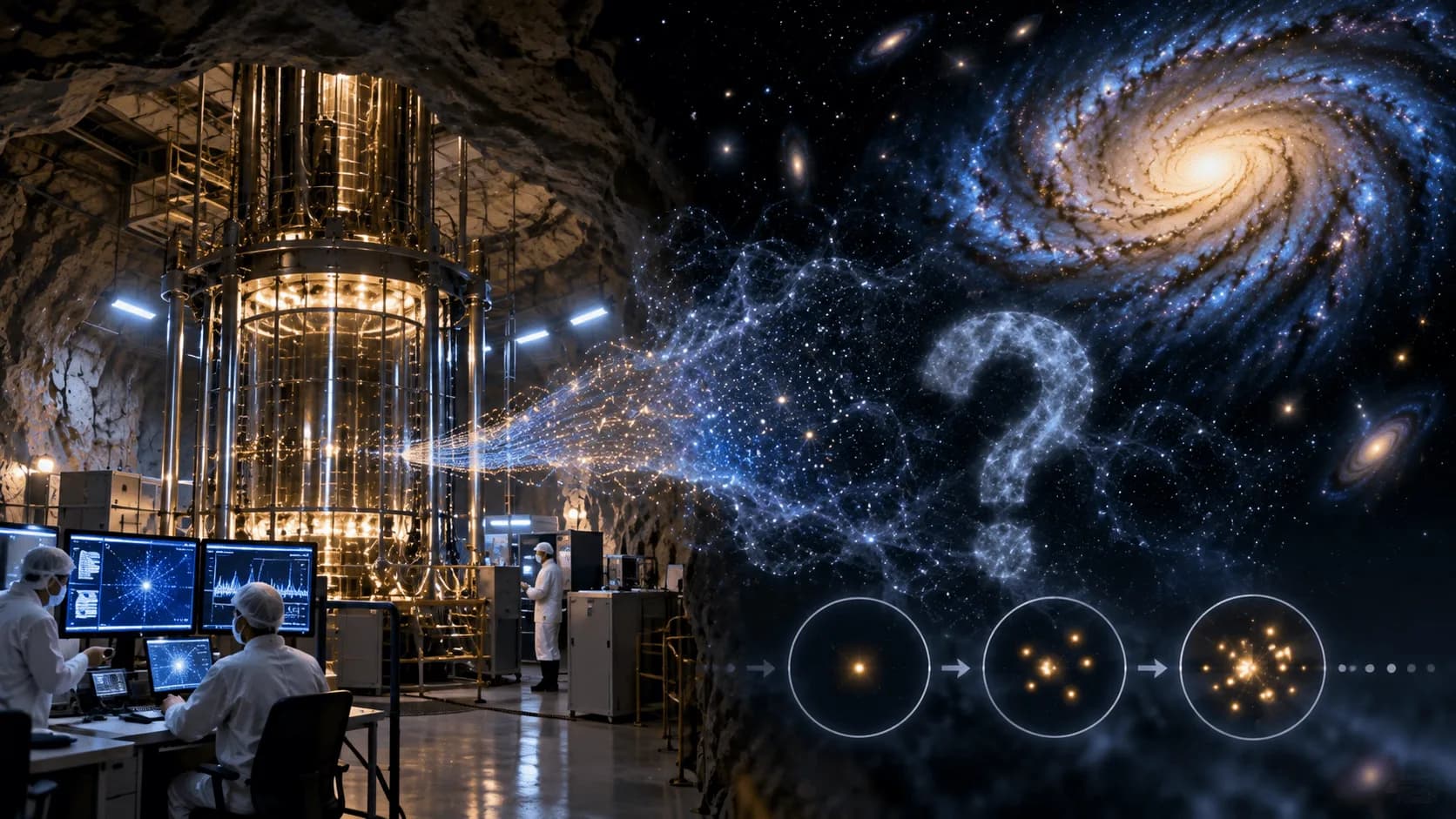
Dark matter has remained one of the universe’s biggest mysteries for decades. Scientists know that something invisible appears to be shaping galaxies and other cosmic structures, yet they have never been able to directly identify what it is. Now, a mysterious signal recorded nearly 1.6 kilometres beneath the ground in a former South Dakota gold mine has brought the search for dark matter back into focus.
Detected by the LUX-ZEPLIN experiment, the unusual event could be linked to a hypothetical dark matter particle, although researchers have stressed that it is far too early to call it a discovery. So, what exactly is this dark matter? Why do scientists believe in its existence and why do they hunt for dark matter underground?
What is dark matter?
Dark matter is a form of matter that does not seem to emit, absorb or reflect any amount of light which is adequate enough to make it detectable through telescopic observations. The term “dark” means that it does not interact with the electromagnetic radiation in any detectable manner; it does not imply any particular color.
Also Read | World Letter Writing day: The stories behind 8 famous letters of love, war, ambition and loss
Scientists estimate that dark matter makes up about 27% of the universe. Ordinary matter, including stars, planets and living things, accounts for roughly 5%. Most of the rest is attributed to dark energy.
How do scientists know dark matter exists?
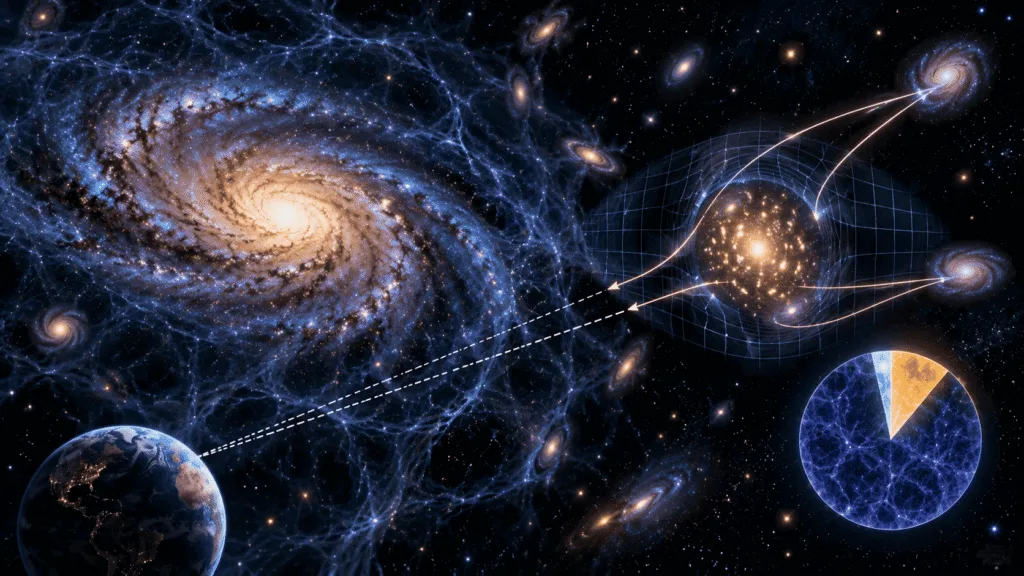
The strongest clues come from gravity. Astronomers have observed galaxies and galaxy clusters behaving as if they contain considerably more mass than can be seen.
In the 1930s, Fritz Zwicky found that galaxies in the Coma Cluster were moving too rapidly for visible matter alone to hold the cluster together. Later, Vera Rubin found that stars in spiral galaxies were also moving faster than expected, particularly those far from their galactic centres.
Gravitational lensing provides another important clue. A large object can bend light emitted from farther away, and that is how scientists detect mass that cannot be seen because of the effect of gravity.
Is dark matter the same as dark energy?
Not necessarily. While dark matter and dark energy are two different concepts, dark matter relates to the gravitational forces that structure galaxies.
Why is the LZ experiment underground?
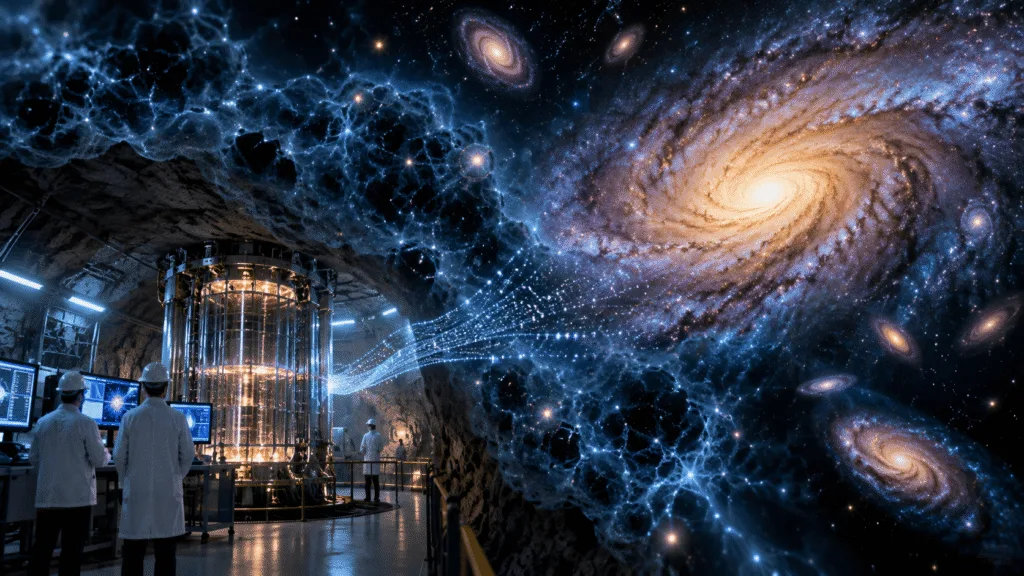
LZ operates around 1.6 kilometres below the surface at the Sanford Underground Research Facility, inside a former gold mine. Underground position ensures less interference caused by cosmic rays and other forms of radiation.
Also Read | Nepal flood: Why unidentified bodies are being buried and how families can identify them later
The detector uses liquid xenon and searches for tiny signals produced when a possible dark matter particle interacts with a xenon atom.
Has dark matter finally been detected?
Not yet. The above-mentioned phenomenon is quite fascinating, but one such strange reading can never be considered as a proof of discovery. There should be more events with a similar behavior pattern for the phenomenon to be proved scientifically.
If dark matter could be discovered at some point of time in the future, it would help to understand better the universe and its evolution. The nature of dark matter continues to be one of the big puzzles of physics.