











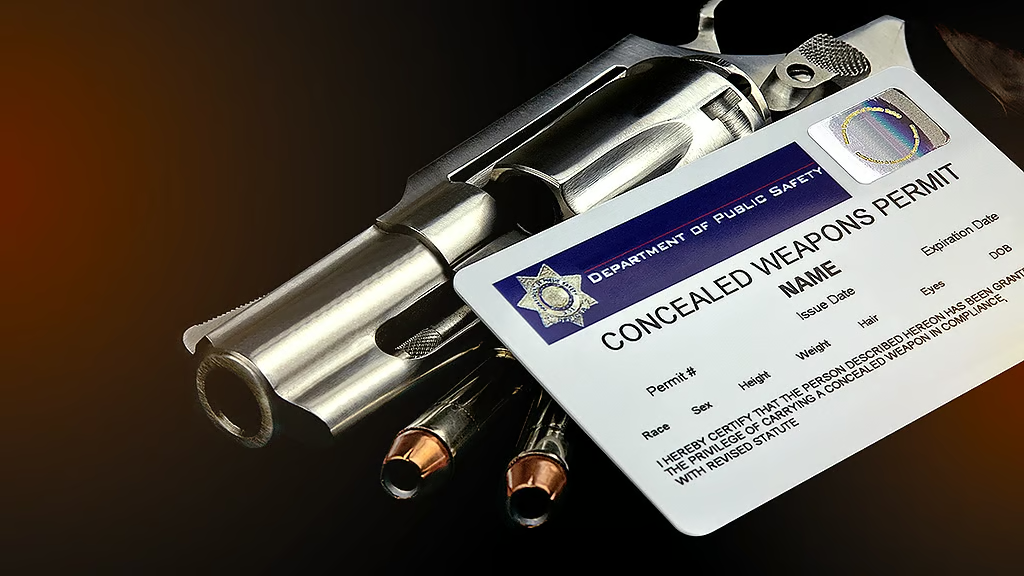
Can an ordinary person in West Bengal actually own a gun? The answer is yes, but it is certainly not as simple as walking into a shop and buying one.
Under the Indian Arms Act, 1959 and the Arms Rules, 2016, civilians can apply for firearms licences under specific circumstances. Broadly, licences are issued for self-defence, business protection and sports shooting. Each category has its own requirements, and simply wanting to own a gun is not enough.
Notably, just in recent weeks, Trinamool Congress MP Kirti Azad said that he would obtain an arms licence for security. That raises a wider question: what about ordinary citizens? What does the law actually allow?
ALSO READ| Is the magic of Bengal’s music now lost, or is another story waiting to unfold?
When can someone get a gun licence for self-defence?
The Arms Act notes that a self-defence licence is primarily meant for people who can demonstrate a genuine threat to their life or property. The authorities do not generally issue such licences merely because an applicant feels unsafe. There has to be some supporting evidence.
Documents that may be required include:
- FIR or GD copy.
- Police record of any previous assault, threats or blackmail allegations.
- Any evidence of threats received through threatening letters or digital means.
People holding sensitive government positions, or those occupying social positions that put their lives at risk, may also apply. Depending on the circumstances and the licence granted, they may be permitted to possess firearms in the Non-Prohibited Bore (NPB) category, including certain pistols, revolvers or shotguns.
What about business owners?
Interestingly, a separate category exists for people whose work involves handling substantial amounts of cash or valuables.
Jewellers, banks, cash-handling agencies, petrol pumps and large distributors, for example, may have a reason to seek additional security where large cash transactions occur regularly.
ALSO READ| Did you know Bengal once had its own airline? Here’s why it never took flight
Then in such cases, applicants have to provide documents including:
- Specific business licences, including trade licences.
- Company’s incorporation certificate.
- Proof of financial transactions.
- Annual turnover ledger.
- GST Return.
- Income Tax Return (ITR).
Can sports shooters get a gun licence?
Yes. Firearms licences can also be issued for sports shooting and target practice. But this category is specifically linked to participation in recognised shooting activities.
The applicant must be an active member of a recognised shooting club or rifle association.
The required documents can include:
National Rifle Association of India (NRAI) or State Rifle Association-approved membership card and certificate.
Shooter ID card (special identity card for sports category).
Proof of active participation in various district, state or national level shooting competitions for 2 years.
What kind of gun can a civilian actually own?
This is where the rules become particularly important. A district police official noted that getting a gun license does not mean that all types of guns can be purchased. He said that no type of automatic rifle, machine gun or any military weapon used by the army can be purchased.
303 rifles, 7.62 mm and high-powered firearms meant for military use also cannot be purchased by ordinary civilians, the official made it clear.
ALSO READ| Who is Sumit Roy? Supreme Court orders not to arrest Abhishek Banerjee’s close aide
With a valid licence, however, certain civilian firearms, such as shotguns and smoothbore guns, may be available. These can include single-barrel or SBBL guns and double-barrel or DBL guns. Depending on the category and conditions of the licence, certain 9 mm pistols may also be permitted.
What is the minimum age?
For personal or business purposes, an applicant must generally be at least 21 years old.
Sports shooting has different provisions. Under special conditions, those aged 12 years and above can apply under the sports category.
How does the application process work?
The applicant has to submit Form A-1, either online or offline, following which the application is sent to the concerned police station. Following this, an officer under the District Magistrate handles the application process in each district.
The police then conduct the necessary verification. A report from the District Intelligence Department is also obtained. The application subsequently moves to the concerned officer under the District Magistrate.
After checking the documents, background information and other details, the file is placed before the District Magistrate. The District Magistrate then takes the final decision after examining the information and verification reports.