












Every once in a while, you stumble upon a story so unbelievable that you instinctively think, “How did I never know about this?” This is one of those stories.
How did the Bengal Air story start?
Nearly three decades ago, during the Communist Government, there was a bold move to start a regional airline in West Bengal. It was long before UDAN and the renewed interest in air connectivity between the east and the northeastern part of India that the state government had a vision of an airline that would do just that.
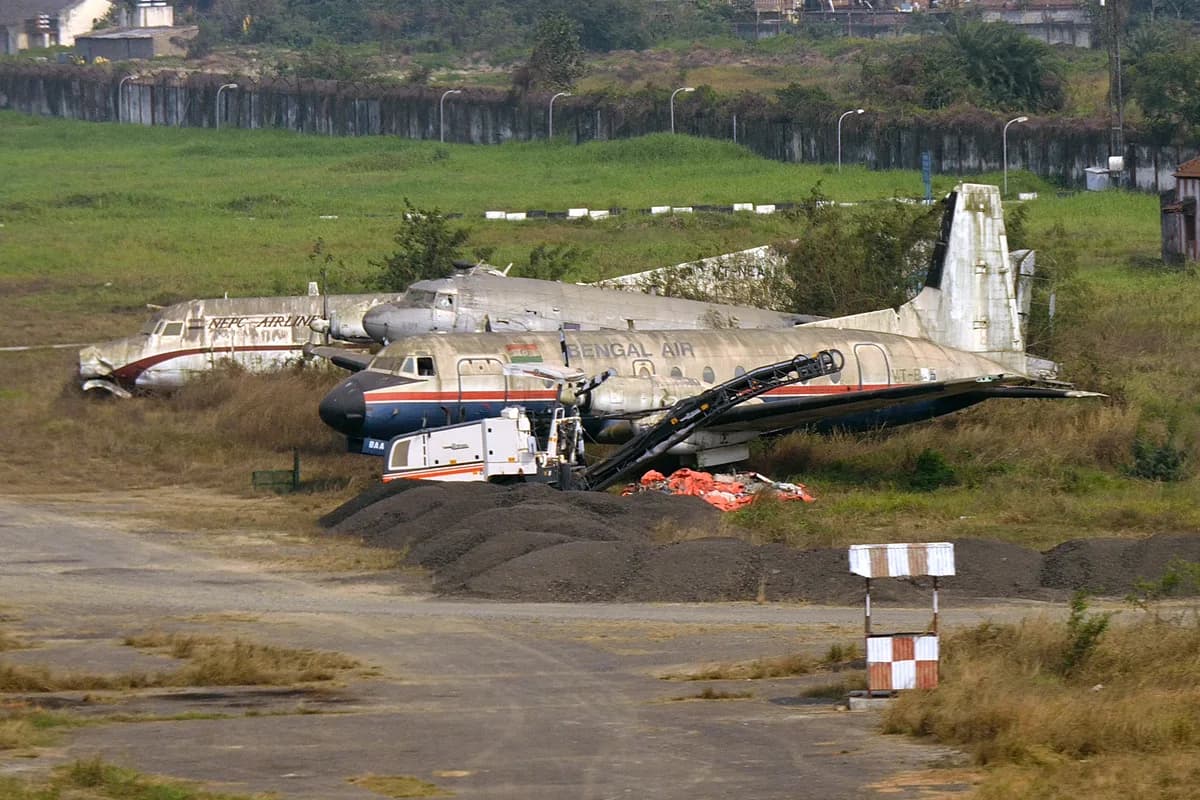
The airline was called Bengal Air. But in 2026, that dead dream survives only as a rusting aircraft lying in a scrapyard near Sonipat, Haryana.
Bengal Air recently made headlines after a YouTube video went viral, where Eastern India’s flying dream was spotted among other scrapped planes. The aircraft was carrying the registration VT-BAA.
ALSO READ| Lok Sabha goes Gen Z: ‘Clock It’, ‘Delulu’ and ‘FOMO’ steal the spotlight during Exam Bill debate
Back in 1998, when the Left Front government under Chief Minister Jyoti Basu was trying to revive Bengal’s industrial landscape, civil aviation emerged as one of the sectors the state wanted to explore. A consortium formed by the West Bengal Industrial Development Corporation (WBIDC) and Bengal Air Services Limited (BASL) proposed launching Bengal Air, a regional airline designed to improve connectivity across eastern and northeastern India.
The plan was simple: to operate three Hawker Siddeley HS-748-2B turboprop aircraft, connecting Kolkata with cities such as Cooch Behar, Bagdogra, Shillong, Agartala, Jamshedpur, Patna, Ranchi, Bhubaneswar and Rourkela.
To support operations, Bengal Air partnered with Nepal’s Necon Air, which agreed to provide technical expertise. Interestingly, both airlines carried remarkably similar Trishul logos on their aircraft tails. At first glance, they looked identical, although Necon Air’s logo included Lord Shiva’s damaru, while Bengal Air’s version featured only the trident.
The aircraft themselves were to be acquired from Canadian company Dellair Trading Inc. Two of them, registered C-GBCY and C-GBCS (later identified as VT-BAB), were photographed waiting at Winnipeg International Airport in 2001, ready for delivery to India.
But then, for reasons that have never been fully explained publicly, the project was called off. The proposed deal with Dellair collapsed before completion. The two aircraft in Canada never reached India.
Where is that single Bengal Air aircraft now?
Even that single aircraft never entered passenger service. Instead, it remained parked at Netaji Subhash Chandra Bose International Airport. Reports suggest that in 2001, the consortium approached the government once again, seeking ₹28 crore to revive the airline and begin operations. The proposal, however, failed to receive the necessary support.
Then, the only Bengal Air aircraft was kept in an abandoned condition at the Dum Dum Airport, Kolkata, for almost 20 years until it was auctioned off as scrap in 2018.
Today, the same aircraft is in a scrap yard near Sonipat in Haryana. It was bought by a businessman who specialises in the acquisition of retired aircraft and refurbishing them for commercial use as restaurants, theme parks or exhibition materials.
Today, very few people remember Bengal Air. There are no airport terminals bearing its logo, no retired pilots sharing stories of its flights, and no passengers recalling journeys aboard its aircraft.
Only a weathered fuselage with the words ‘Bengal Air’ painted across its side remains.