














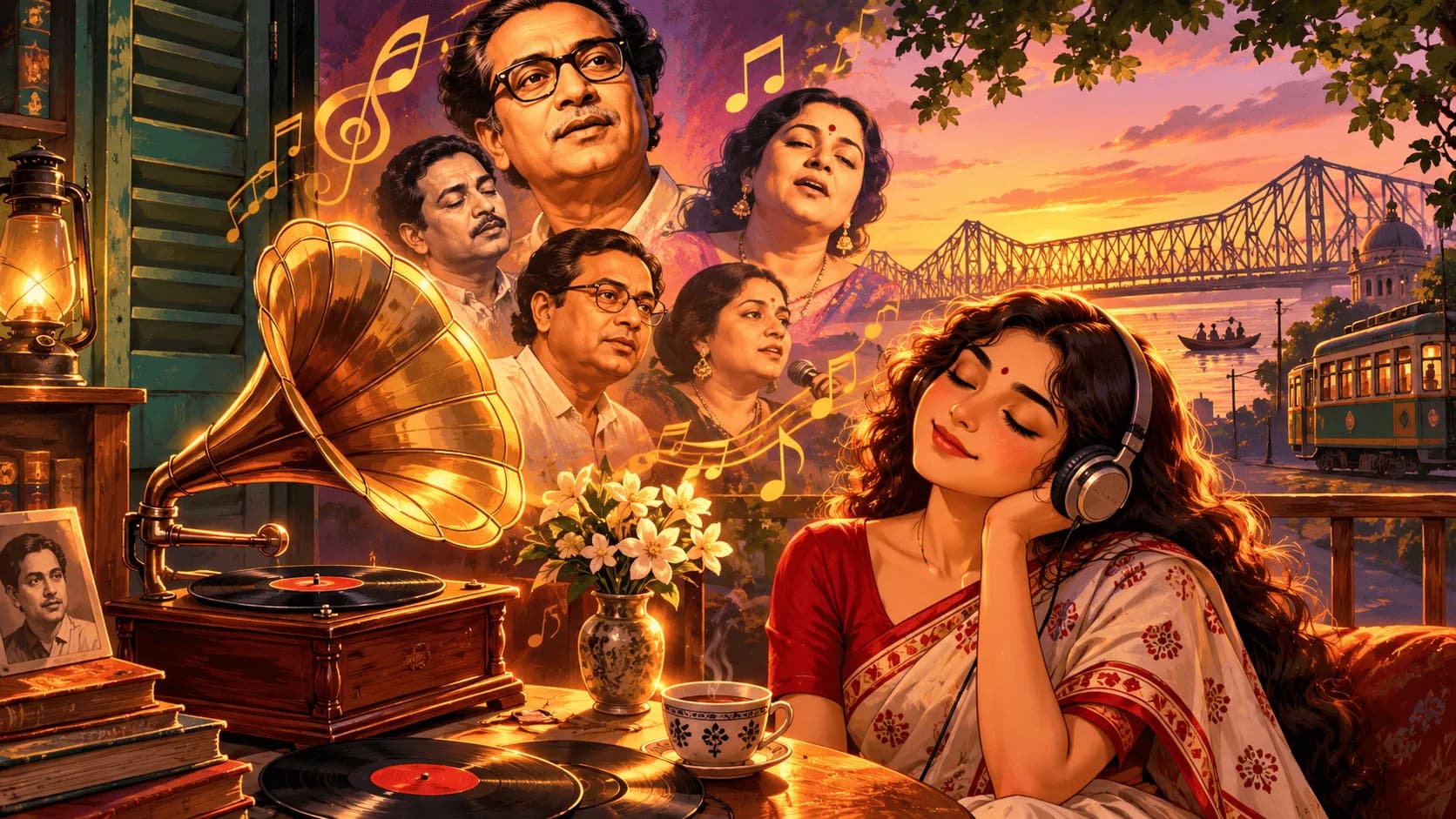
There was a time when Bengal did not merely produce music; it possessed a musical civilisation.
Its songs were not disposable embellishments to cinema, nor ephemeral commodities engineered for a weekend’s streaming numbers. They were cultural artefacts, carrying within their melodies the melancholy of a river, the romance of a rain drenched afternoon, the anguish of partition, the exuberance of youth and the philosophical resignation that Bengalis have long perfected into an aesthetic virtue.
The greats did not simply sing songs. They fashioned an idiom.
Hemanta Mukhopadhyay possessed a baritone that could make solitude sound almost aristocratic. Manna Dey brought classical rigour into popular music without sacrificing accessibility. Sandhya Mukhopadhyay invested romantic longing with an almost operatic tenderness. Shyamal Mitra, Manabendra Mukhopadhyay, Dwijen Mukhopadhyay and Aarti Mukherji added their own hues to an extraordinarily variegated canvas. Behind them stood composers and lyricists such as Salil Chowdhury, Sudhin Dasgupta, Nachiketa Ghosh and Pulak Bandyopadhyay, whose collaborations created songs that have outlived the films for which they were composed.
Also Read | Did you know Bengal once had its own airline? Here’s why it never took flight
Sudhin Dasgupta alone worked with an astonishing constellation of voices, including Hemanta, Manna Dey, Shyamal Mitra, Sandhya Mukhopadhyay, Lata Mangeshkar, Asha Bhosle, Mohammed Rafi and Talat Mahmood.
This was Bengal’s great musical paradox: it was fiercely Bengali without ever being culturally insular.
Calcutta and Bombay were not rival musical republics. They were neighbouring provinces of the same imagination. Lata Mangeshkar could sing in Bengali; Kishore Kumar could become an intrinsic part of the Bengali sonic memory; Salil Chowdhury could carry the political conscience and melodic sophistication of Bengal into Hindi cinema. The traffic was not merely commercial. It was artistic.
That cosmopolitanism has gradually receded and the decline did not arrive with the theatricality of an obituary. It came insidiously, through changing economics, altered listening habits and the transformation of cinema music into content. The old ecosystem, in which lyricists, composers, arrangers, singers and musicians could develop enduring artistic partnerships, slowly fragmented. The song became shorter, the production more immediate, the shelf life more precarious.
What disappeared was not talent and Bengal has never been bereft of talent.
What disappeared was the ecosystem that could turn talent into a musical era. This distinction is crucial.
A generation ago, a composer could acquire a signature. A singer could cultivate a recognisable musical personality. A lyricist could become inseparable from a certain emotional vocabulary. Today, songs arrive amid an avalanche of releases, competing not merely with other songs but with reels, remixes, algorithms and an attention span increasingly atomised by the tyranny of immediacy.
And then came the Dev era.
The rise of Dev in Bengali commercial cinema, particularly through the enormously popular soundtracks of films such as Paglu, Shedin Dekha Hoyechilo and others, produced one of the last conspicuous manifestations of Bengal’s older cosmopolitan musical instinct. Jeet Gannguli became a formidable musical force, while voices from the Bombay playback establishment, including Sonu Nigam, Shaan and Kunal Ganjawala, became integral to Bengali popular cinema.
It was commercially unapologetic, musically contemporary and unmistakably ambitious.
Also Read | Who was Kamal Senapati? Hooghly railway officer dies after being hit by train
More importantly, it demonstrated that Bengali cinema could still summon Bombay’s most recognisable voices and make them sing to a Bengali audience at considerable scale. Songs such as Je Kothati Mone and Shey Chhilo Boroi Anmona became chartbusters, evidence that linguistic particularity did not necessitate musical insularity.
Perhaps that was the last grand bridge between two musical cultures that once conversed with enviable ease.
Today, the irony is almost painful. The old songs refuse to die even as the ecosystem that created them has largely disappeared. They survive in Puja playlists, late night radio, streaming algorithms, family archives and the accidental nostalgia of a younger generation discovering that their grandparents’ music possesses something contemporary music often struggles to manufacture: permanence.
Bengal’s lost musical diadem, therefore, is not really lost.
Its jewels remain scattered across decades of recordings. What has been misplaced maybe is the crown.
And perhaps the challenge before Bengali music is not to resurrect the past, for nostalgia is a poor substitute for creation, but to recover the confidence of that past: the audacity to compose ambitiously, to sing without haste, to write with literary precision and to believe that a Bengali song can travel beyond Bengal without first surrendering its Bengali soul.
For music, like civilisation, does not perish when its practitioners change. It perishes when a culture ceases to believe that what it creates is worthy of being remembered.