










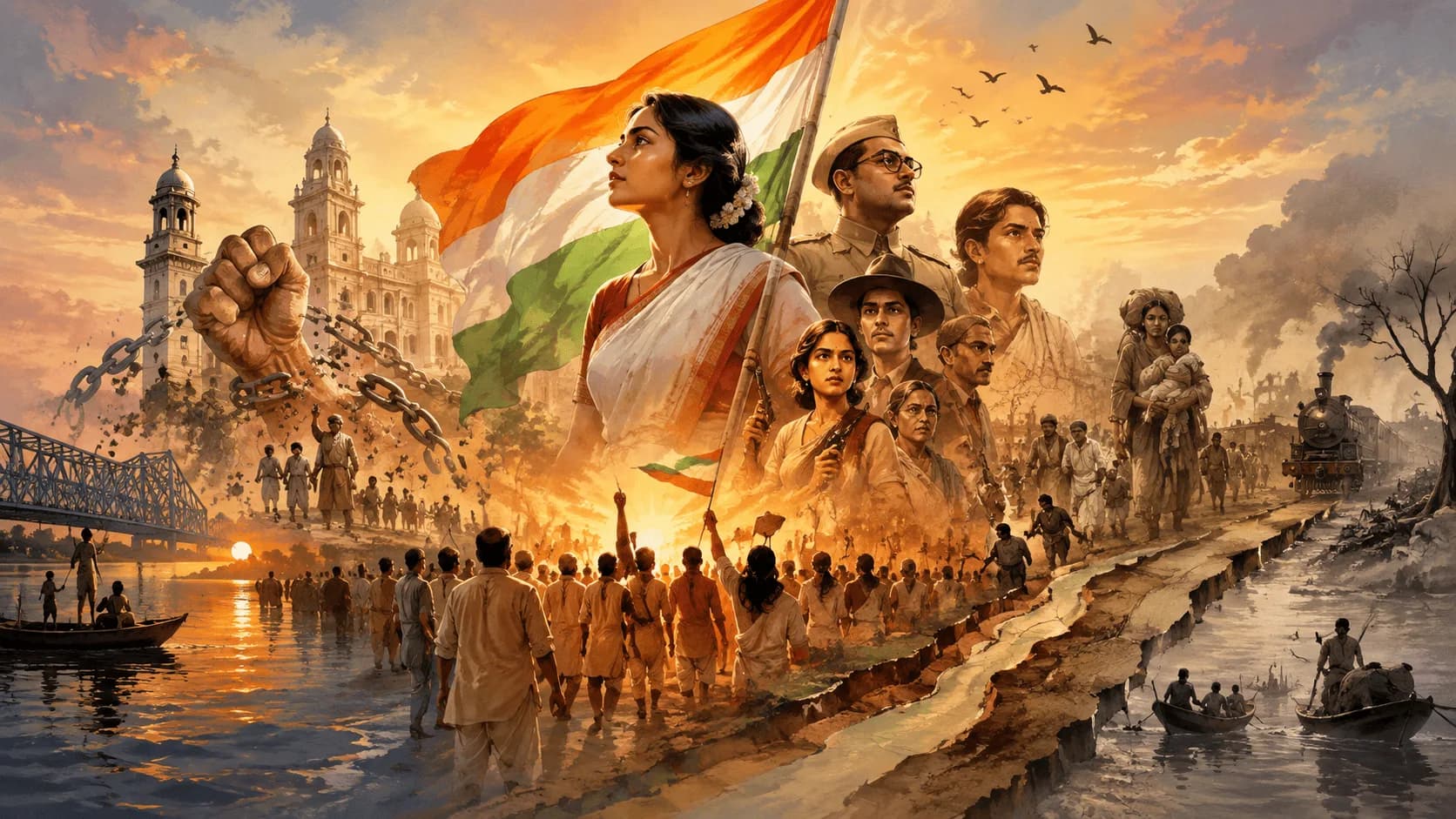
On the night India crossed the threshold of freedom, Bengal occupied a peculiar and almost tragic position in the national imagination: it was at once one of the principal nurseries of Indian nationalism, the birthplace of movements that had challenged the moral authority of the Raj long before independence became an attainable political proposition, and the province that would experience the arrival of freedom through the violence of Partition, with Calcutta itself suspended between jubilation and apprehension. While New Delhi prepared for the ceremonies that would accompany the transfer of power, Bengal confronted a more complicated dawn, for the liberation of a country had arrived alongside the division of a homeland that had for generations been imagined, inhabited and remembered as a cultural whole. Eight decades later, as India marks its 80th Independence Day, that contradiction remains indispensable to any serious understanding of what freedom meant to Bengal and what Bengal, in turn, meant to the making of India.
Long before 15 August became the ceremonial vocabulary through which an independent republic would annually remember itself, Bengal had already supplied much of the intellectual and emotional grammar of the freedom movement. The first Partition of Bengal in 1905, conceived by the colonial administration ostensibly for reasons of administrative convenience but widely perceived as an attempt to fracture an increasingly politically conscious population, produced the Swadeshi movement and transformed resistance from an abstract political sentiment into an everyday practice of boycott, indigenous enterprise, national education and cultural assertion. The streets, classrooms, printing presses and drawing rooms of Bengal became laboratories of nationalism, while literature, music and theatre acquired a political potency that the colonial state found increasingly difficult to contain. Rabindranath Tagore’s songs, Bankim Chandra Chattopadhyay’s Vande Mataram and the writings of a generation of intellectuals did something that political resolutions alone could not accomplish: they gave the idea of India an emotional vocabulary.
Yet Bengal’s nationalism was never confined to the genteel world of intellectual debate. Beneath the public movement existed a subterranean republic of revolutionaries, whose names would eventually become inseparable from the mythology of India’s struggle for independence. Khudiram Bose, barely eighteen when he was executed in 1908, entered nationalist memory as the embodiment of a generation for whom colonial rule had ceased to appear merely unjust and had instead become intolerable; the organisations associated with Anushilan Samiti and Jugantar subsequently cultivated networks of young men who regarded armed resistance as an alternative to petitions, negotiations and constitutional gradualism. Their methods remain historically contentious, and their violence cannot responsibly be romanticised, but their importance lies in what they revealed about the changing psychology of colonial India: the British Empire, once presented as an almost permanent fact of political life, had begun to appear vulnerable to challenge.
Also Read | Is the magic of Bengal’s music now lost, or is another story waiting to unfold?
That transformation found one of its most formidable expressions in Subhas Chandra Bose, whose political imagination was perhaps too impatient to accommodate itself to the incrementalism of conventional nationalist politics. Netaji’s journey from Congress president to leader of the Indian National Army remains one of the most contested trajectories in the history of India’s freedom struggle, particularly because his wartime alliances with the Axis powers continue to invite legitimate historical scrutiny; yet reducing Bose either to a military romantic or to the controversies surrounding his wartime diplomacy would be to miss the larger significance of his politics. He understood freedom not merely as the legal transfer of sovereignty but as a psychological emancipation, requiring Indians to cease thinking of themselves as subjects awaiting political concessions and to imagine themselves instead as the authors of their own destiny. His famous call to sacrifice was consequently less a piece of rhetoric than an attempt to manufacture political agency among a colonised people.
Bengal’s contribution to the freedom movement was, moreover, never exclusively male, nor was it confined to the celebrated names that populate school textbooks. Pritilata Waddedar, Kalpana Dutta and Bina Das belonged to a generation of women who entered political resistance at considerable personal risk, while Matangini Hazra, the elderly Gandhian revolutionary from Tamluk, became one of the most enduring symbols of the Quit India Movement when she continued advancing with the national flag after being shot by the colonial police in 1942. In the parallel nationalist administration established in Tamluk during the Quit India period, Bengal demonstrated another dimension of resistance: the capacity not merely to oppose colonial authority but to experiment, however imperfectly and briefly, with alternative forms of political organisation.
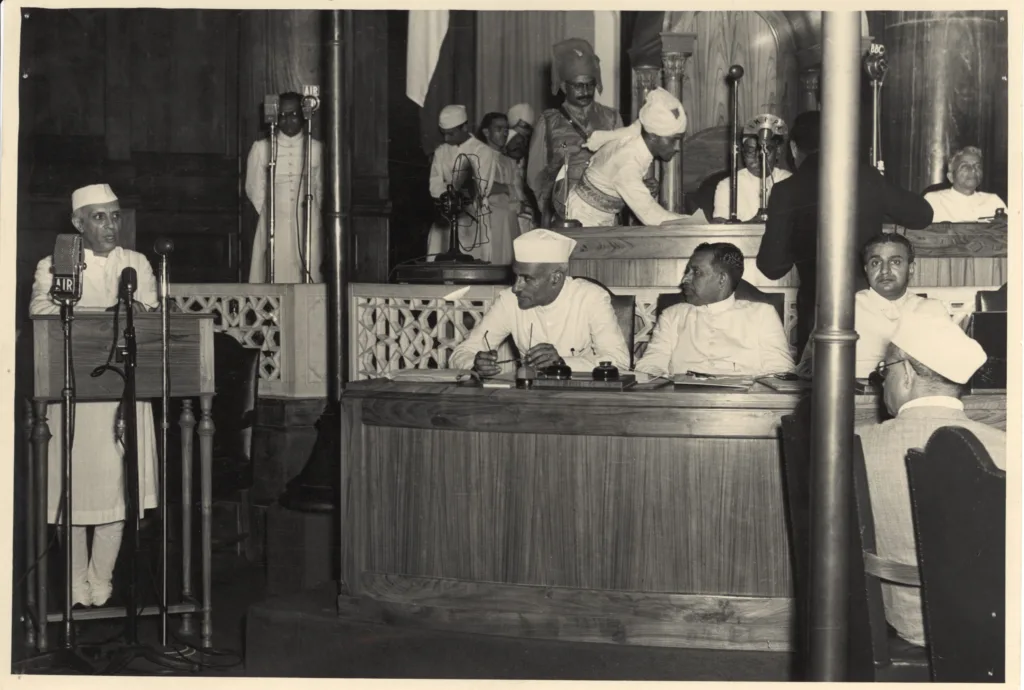
And then came 1947, carrying with it the strange cruelty that history sometimes reserves for places that have contributed most passionately to its making. Nehru’s celebrated Tryst with Destiny speech, delivered on the eve of independence, imagined India awakening to life and freedom after a long night of subjugation; Bengal entered that same dawn with the knowledge that freedom had also redrawn the map beneath its feet. The partition of Bengal divided families, disrupted economies, displaced millions and transformed the meaning of home for communities on both sides of the new border. Calcutta, which had once stood at the centre of an undivided Bengal and had served as the capital of British India until 1911, became a city negotiating the enormous human consequences of Partition even as the new republic attempted to celebrate its arrival.
This is why the Bengal story of Independence cannot be reduced to nostalgia, however seductive nostalgia may be. To remember Khudiram is to remember the ferocity of youthful conviction; to remember Surya Sen is to remember the audacity of organised rebellion; to remember Pritilata and Matangini is to recognise how extensively women participated in the making of freedom; to remember Netaji is to confront the complexity of nationalism itself; and to remember Partition is to understand that political liberation can coexist with profound human loss. The inheritance is therefore not a simple pantheon of heroes but a complicated archive of courage, disagreement, idealism, violence, sacrifice and grief.
For India in 2026, that archive acquires renewed significance because the meaning of freedom has inevitably changed. The generation that fought the Raj sought sovereignty; the generation that inherited sovereignty has had to confront poverty, illiteracy, inequality, communal tension, institutional weakness and the enormous challenge of converting political independence into substantive opportunity. The India that now speaks of becoming a developed nation by 2047 is consequently engaged in a second, very different kind of freedom struggle: not against an external sovereign, but against the internal constraints that prevent citizens from exercising the full possibilities of independence.
Also Read | Did you know Bengal once had its own airline? Here’s why it never took flight
Bengal, which once supplied so much of the intellectual energy of India’s freedom movement, must find its place within that unfinished project. The challenge is no longer to overthrow an empire, but to build institutions capable of sustaining aspiration; no longer to demand Swaraj, but to translate political liberty into economic dynamism, educational excellence, technological confidence and social dignity. The Bengal that produced revolutionaries, poets, scientists, reformers and political thinkers cannot afford to treat its history as a museum of former greatness; its more demanding obligation is to convert that inheritance into a capacity for renewal.
Perhaps, then, the most appropriate way to observe Independence Day in Bengal is neither through triumphalism nor through melancholy, but through a more demanding act of remembrance. Eighty years after Nehru spoke of India’s tryst with destiny, the tryst remains unfinished, because freedom, once achieved, does not become self-sustaining merely by virtue of being inherited. Every generation must decide what it will do with the political inheritance placed in its hands.
The tricolour that rises over Bengal each August therefore carries within it more than the memory of 1947. It carries the unfinished arguments of 1905, the courage of the revolutionaries, the imagination of Tagore, the defiance of Netaji, the sacrifice of Matangini and Pritilata, the wounds of Partition and the aspirations of millions who inherited freedom without ever having witnessed its birth. The awakening of 1947 gave India its sovereignty; the responsibility of 2026 is to determine what that sovereignty can become.
And perhaps that is the most enduring lesson Bengal can offer a country approaching its centenary: that freedom is not a destination reached at midnight, but a promise whose meaning must be renewed at every dawn.