
















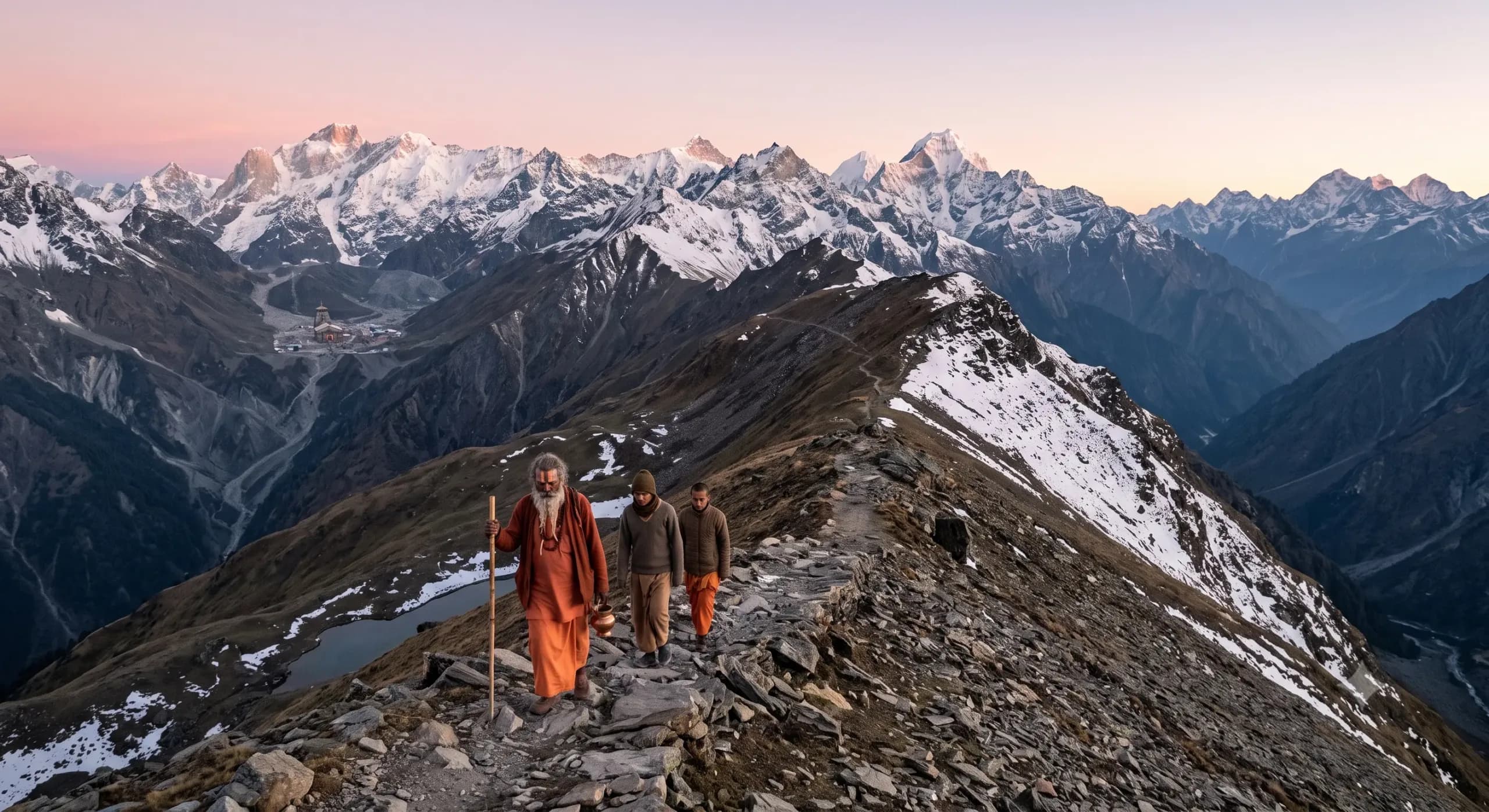
There is one story that still intrigues devotees and trekkers of the Garhwal Himalayas: Dev Marg, the lost trail between Kedarnath and Badrinath. The journey between the two revered shrines is now a long road ride through the winding mountain roads, dipping down deep in the river valleys before returning to the high Himalayan mountains, taking up to several hours for the almost 200 kilometres of distance.
But, but local folklore tells a very different story.
Well before the advent of roads, helicopters and organised pilgrimages, there is a story of saints and wandering ascetics and the Himalayan shepherds following a path through an ancient mountain track that connected the two temples virtually. The path is known as the Dev Marg, the Path of the Gods, in Garhwali tradition, where it was believed pilgrims would pass over high ridges of the Himalayas and reach Lord Vishnu’s shrine at Badrinath and Lord Shiva’s at Kedarnath without being forced to go down to the populated valleys below.
ALSO READ| Why is Shiva worshipped as a Lingam while other gods have idols?
Whether this mysterious trail was once a functioning pilgrimage route or has since become part history and part legend remains a matter of debate, though. Yet even today, stories of the hidden path continue to echo through the mountains.
This is not one of the miracle-based legends that often starts with a miracle and progresses from there, but rather one that started with geography. The Garhwal Himalayas are a huge catchment of glacial valleys backed by high ridges and concealed passes and snowfields that are untraveled for most of the year. Today’s trekkers are aware of many ancient shepherd paths that have traversed these mountains, long before this area was reached by roads. Many of these trails have been buried under ice, and some are only partially preserved.
It is in this topography that the secret route of Kedar-Badri came into being. The locals think that Lord Shiva, after giving Lord Vishnu Badarikashrama as his seat of meditation, moved west and became Lord Kedarnath at Lord Vishnu’s place of meditation.
How the Puranas Inspired the Legend of the Hidden Kedar–Badri Route
However, the break-up was never perceived as a partition. The Puranas repeatedly remind us that Shiva and Vishnu are two manifestations of the same Supreme Reality. The two sanctums are, therefore, said to have been spiritually united by an invisible Himalayan corridor which was traversed by the sages who were engaged in tapasya and not by ordinary pilgrims.
Old Garhwali ascetics describe the route not as a single well-defined trail but as a sequence of glaciers, alpine meadows and high passes stretching across some of the most isolated terrain in the central Himalayas. Beginning beyond Kedarnath, the path is believed to pass through regions associated with Vasuki Tal, climb towards remote snowfields and eventually descend through glacial basins leading into the upper Alaknanda valley near Badrinath.
Notably, Modern mountaineering expeditions have identified difficult alpine crossings in this broader region, but there is no recognised pilgrimage trail linking the two temples directly. The legend therefore survives primarily as folklore.
What makes this forgotten path particularly fascinating is the role it plays in the spiritual imagination of the Himalayas. Ancient ascetics were rarely interested in the easiest route. Their journeys themselves formed part of their discipline. To cross glaciers, endure freezing winds and walk for days without encountering another human being was not considered hardship alone; it was a means of quieting the restless mind. The hidden route from Kedarnath to Badrinath therefore came to symbolise the inward path travelled by those who had already transcended the ordinary concerns of worldly life.
Several wandering monks have claimed over the centuries that certain Himalayan sadhus continued to use sections of this route during favourable weather, though such accounts remain impossible to verify. These narratives often describe isolated caves where unnamed yogis spent years in meditation, surviving on glacial water, wild herbs and offerings occasionally brought by shepherds.
Whether every account is historically accurate is less important than what they reveal about the Himalayan tradition itself. The mountains have always been imagined as preserving a spiritual world largely hidden from ordinary sight, a realm where renunciation continues quietly beyond the reach of history.
What do these two ‘Nath’ symbolise?
Kedarnath represents vairagya, the path of renunciation embodied by Shiva. Badrinath represents dhyana, the path of contemplative preservation embodied by Narayana. To walk from Kedarnath to Badrinath is therefore to move from renunciation towards inner balance, from the fierce austerity of Mahadeva to the serene meditation of Vishnu. The physical trail becomes a metaphor for the evolution of consciousness itself.
Then this deeper meaning is reflected in the annual pilgrimage traditions of the Himalayas. Even though devotees travel by road today, many still consider it spiritually appropriate to visit
Kedarnath before Badrinath. Local priests often explain that one first seeks the blessings of Shiva, who removes ignorance and ego, before approaching Narayana, who grants wisdom and inner peace.
Modern satellite imagery, trekking surveys and geological studies reveal that the region between Kedarnath and Badrinath is among the most rugged anywhere in the Himalayas.
Massive glaciers, unstable moraines, avalanche-prone slopes and rapidly changing weather make direct travel extraordinarily hazardous. These findings help explain why no continuous pilgrimage route survives today. It is entirely possible that ancient shepherd tracks once crossed parts of this landscape before glacial movement, earthquakes and landslides gradually erased them. The Himalayas are geologically young mountains, constantly reshaping themselves through tectonic activity and erosion. Trails that existed a thousand years ago may no longer exist in recognisable form.
This meeting of geology and mythology is characteristic of the Himalayas. Science explains how landscapes evolve through natural processes; tradition preserves the meanings people discovered within those landscapes. The legend of the secret Kedar–Badri route may therefore contain memories of genuine high-altitude crossings transformed over centuries into sacred narrative.
The real path between Kedarnath and Badrinath lies within the seeker.