















NASA’s return to the Moon has a name rooted not in modern science, but in ancient Greek mythology.
The space agency named its lunar programme Artemis, after the Greek goddess who was associated with the Moon, nature and hunting. Artemis was also the twin sister of Apollo, the god of the Sun, making the name an intentional connection to NASA’s historic Apollo lunar programme.
Also Read | Sita, Draupadi and the forgotten voices being reclaimed through mythology
But there is another reason the name carries particular significance. The Artemis programme was designed with an ambition to expand the role of women in America’s renewed lunar exploration efforts.
Who was Artemis in Greek mythology?
Artemis was one of the major Olympian deities in ancient Greek mythology. She was the daughter of Zeus and Leto and the twin sister of Apollo.
The Greeks associated Artemis with the Moon, nature and hunting, while also connecting her with chastity and childbirth. She was often depicted carrying a bow and arrow or alongside deer.
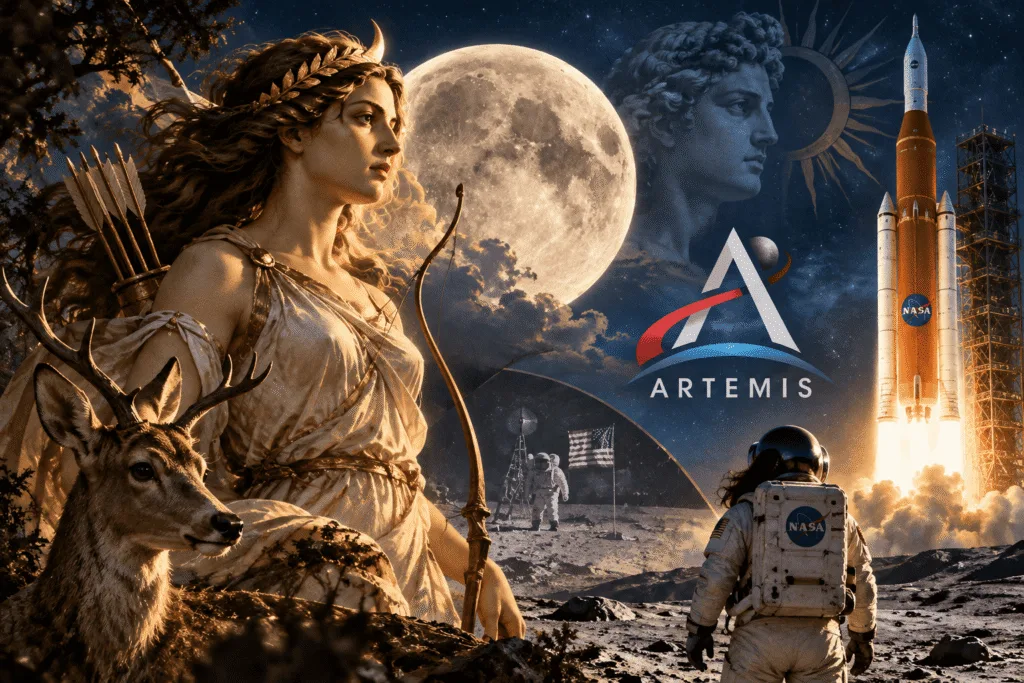
The goddess was also known as Diana in Roman mythology.
The poet Homer referred to Artemis as the “Mistress of Animals” or “She of the Wild”, reflecting her strong association with nature and the wilderness.
How is Artemis connected to NASA’s Apollo programme?
The connection is particularly fitting because Artemis was the twin sister of Apollo.
NASA’s Apollo programme famously carried astronauts to the Moon between 1969 and 1972. When the agency began developing its new generation of lunar missions, choosing the name Artemis created a direct mythological link to Apollo.
🎮 Artemis III: Loading…
— NASA Artemis (@NASAArtemis) July 9, 2026
From hardware deliveries to key milestones, progress toward our next mission is moving full speed ahead with SLS hardware arriving at @NASAKennedy.
Stay in the game with recent updates as we prepare for Artemis III. https://t.co/aGAmweeaB2 pic.twitter.com/2jPXPASF42
The Artemis programme was intended to take the next step in lunar exploration, with Artemis I serving as a test mission for NASA’s new Space Launch System rocket and Orion spacecraft.
Why does the name have a connection with women in space?
The choice of Artemis also reflected the programme’s ambition to bring more women into lunar exploration.
Women made up around 30 per cent of the crew involved in designing and constructing Artemis I, while the spacecraft carried two mannequins to study the effects of radiation on female bodies.
The broader ambition was for Artemis III to carry the first woman and the first person of colour to the lunar surface.
That made Artemis more than just a reference to Greek mythology. The name was also intended to symbolise a new phase of lunar exploration after the Apollo era.
What are the most famous myths about Artemis?
Artemis is portrayed in Greek mythology as a powerful and often fiercely protective goddess.
One well-known story involves the hunter Actaeon, who accidentally saw Artemis while she was bathing. Angered by the intrusion, she transformed him into a stag, after which he was attacked by his own hunting dogs.

Another myth involves Callisto, one of Artemis’s companions. After Callisto became pregnant by Zeus, Artemis was said to have transformed her into a bear. Zeus ultimately intervened and placed Callisto and her son Arcas among the stars, where they became associated with Ursa Major and Ursa Minor.
These myths also reflect the ancient Greek understanding of Artemis as a formidable figure connected with the natural world.
Why is Artemis such a fitting name for a Moon mission?
The name brings together several ideas associated with NASA’s lunar ambitions: the Moon, exploration, nature, independence and the legacy of Apollo.
Also Read | Before Greek myths became Hollywood blockbusters, they were weapons of political parody
Artemis represents the mythological counterpart to Apollo while also carrying a distinctly different identity. For NASA, the name therefore offered a way to connect its next chapter of lunar exploration with the programme that first put humans on the Moon.
From an ancient goddess associated with the wilderness to the name of a modern spacecraft programme, Artemis connects mythology with humanity’s continuing fascination with the Moon.