








Long before Dragon Ball became one of the world’s most recognisable anime franchises, its basic idea was connected to a centuries-old Chinese literary tradition. Akira Toriyama did not simply create a martial arts adventure from scratch. He borrowed characters, themes and ideas from Journey to the West, the famous Chinese novel traditionally attributed to Wu Cheng’en, and reworked them into a fast-moving manga filled with martial arts, comedy and fantasy.
The connection is especially visible in the original Dragon Ball manga. However, it is important to describe the relationship as an inspiration rather than a direct retelling. Toriyama took the framework of the older story and transformed it into something distinctly his own. He once described his intention as creating a kind of “modern Saiyuuki”, with Saiyuuki being the Japanese name for Journey to the West.
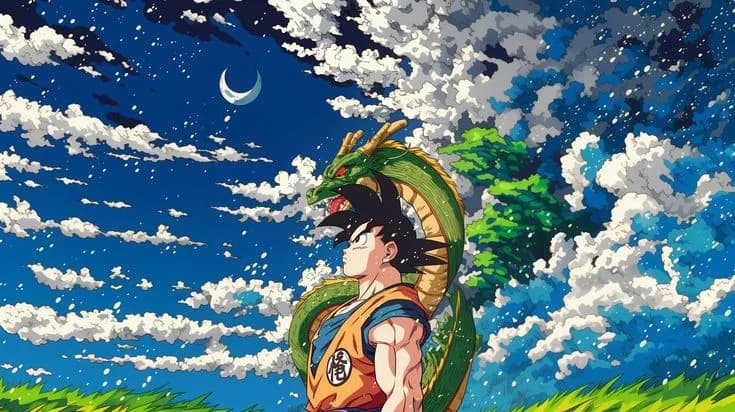
Goku is Toriyama’s version of the Monkey King
The strongest connection is between Son Goku and Sun Wukong, the legendary Monkey King.
Even Goku’s Japanese name, Son Goku, is derived from Sun Wukong. Both characters are extraordinary fighters with supernatural abilities, a mischievous personality and a strong appetite for adventure. Early Dragon Ball also gave Goku several features that immediately recalled the Monkey King, including a magical staff and a flying cloud.
Sun Wukong’s famous weapon is the Ruyi Jingu Bang, a staff capable of changing its size. Goku’s Power Pole serves a similar purpose. The Monkey King also travels on a magical cloud, while Goku rides the Flying Nimbus.
There is another striking parallel in their ability to transform. Sun Wukong possesses numerous transformations, while young Goku can turn into a gigantic ape under the full moon. These similarities helped establish Goku as a modern reinterpretation of one of Chinese mythology’s most famous heroes.
Bulma, Oolong and Yamcha have roots in the ancient journey
Goku is not the only early Dragon Ball character connected to Journey to the West.
Bulma is loosely based on Tang Sanzang, also known as Tripitaka, the Buddhist monk at the centre of the original pilgrimage. The gender and personality are radically different, but Bulma occupies a similar structural position as Goku’s companion during the early search for the Dragon Balls.
Also Read | Mythology of white Hindus and the Western gaze on Hinduism
Oolong has a much clearer connection. The shape-shifting pig is inspired by Zhu Bajie, one of Tang Sanzang’s companions. Zhu Bajie is known as a comic, flawed character, and Oolong similarly provides much of the humour in the early story.
Yamcha, meanwhile, draws from Sha Wujing, another member of the pilgrimage party. Yamcha begins Dragon Ball as a desert bandit before gradually becoming one of Goku’s allies.
The early Dragon Ball adventure itself also echoes Journey to the West. Instead of travelling across Asia to obtain Buddhist scriptures, Goku and his companions travel in search of seven magical Dragon Balls.
The influence goes beyond the main characters
Other parallels can be found throughout the franchise, although they should not all be treated as confirmed one-to-one adaptations.
Tien Shinhan is often associated with Erlang Shen, a powerful deity who battles Sun Wukong in Journey to the West. Master Roshi has also been linked to the sage Subodhi, who teaches Sun Wukong supernatural abilities in the Chinese classic. The Ox-King and Chi-Chi similarly have parallels with the Bull Demon King and Princess Iron Fan.
At the same time, Dragon Ball draws from a much wider range of Asian cultural influences. Toriyama was heavily influenced by Hong Kong martial arts cinema, particularly films starring Jackie Chan. He wanted to combine the adventurous structure of Journey to the West with kung fu and a more contemporary manga style.
How Toriyama transformed an ancient epic
What makes Dragon Ball interesting is not simply that Toriyama borrowed from an old story. It is the way he changed it.
The religious pilgrimage became a treasure hunt. A Buddhist monk became a teenage inventor. A legendary Monkey King became a cheerful martial artist. Ancient supernatural adventures were mixed with capsules, spaceships, tournaments and science fiction.
Also Read | Why does Mahalaya mark Goddess Durga’s arrival? The myth and meaning behind the ritual
The result was not a reproduction of Journey to the West. It was a new work built from an old cultural foundation.
That is why the mythology behind Dragon Ball remains so fascinating. Millions of viewers may have first encountered Goku as a young martial artist, but beneath his story lies one of China’s most influential literary traditions. Toriyama took that centuries-old material, reshaped it for a modern audience and helped carry elements of Asian mythology into global pop culture.