














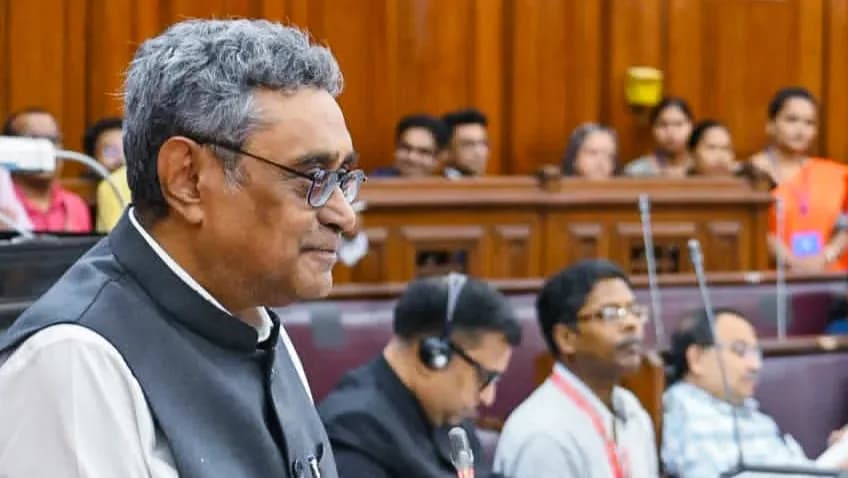
On Thursday, Finance Minister Swapan Dasgupta said the West Bengal government is exploring legislative changes, land pooling, and other reforms to address long-standing difficulties around land use.
Land remains Bengal’s knotty question
Speaking at Business Today’s India at 100 event, Dasgupta described land as one of West Bengal’s most difficult issues. He said the challenge comes from both limited land availability and the fragmented nature of land holdings in the state.
“Land is always a ticklish issue in West Bengal because of two reasons. One, it is in short supply due to sheer population pressure, and secondly, land holdings tend to be of handkerchief size,” Dasgupta said.
ALSO READ| Can you buy a gun for self-defence in West Bengal? Know the rules
The minister said some of the existing land tenures are highly complicated. In some cases, he argued, the rules make it difficult to sell or use land for new purposes. His immediate focus, he said, would be to simplify the legal framework governing land use.
“We have to first get a large amount of legislation done to simplify land use,” Dasgupta said.
Simplifying the rules, parcel by parcel
The proposed approach is not limited to changing land laws. The state is also experimenting with land pooling arrangements, a model that brings together fragmented parcels of land for planned development.
Dasgupta pointed to Gujarat and Haryana as states where such arrangements have been used successfully.
At the same time, he cautioned against expecting West Bengal to offer unlimited land for industrial or commercial projects. The state has high population density and limited availability of large parcels, making land a structural constraint.
“But land is always going to be an issue in Bengal. I am not going to minimise its importance,” he said.
West Bengal wants to shed ‘difficult for business’ tag
The government’s larger goal is to change the perception that West Bengal is difficult for businesses.
Dasgupta said investment decisions are not determined only by financial incentives. Other states may offer more attractive incentives, he noted, but West Bengal wants to compete by highlighting its broader economic ecosystem.
ALSO READ| Why do the survivors describe the Kolkata hotel fire as ‘a scene from a horror movie’?
“We have a tradition. We have a skilled workforce. We have a reasonably livable city. We have all these things,” Dasgupta said, adding that the state’s infrastructure has also improved and needs further strengthening.
The land reforms are part of a wider push for deregulation. Dasgupta said the government is also examining ways to use existing assets to improve state finances.
He described public debt as a major challenge and said the government would have to consider measures including deregulation, privatisation, and the better use of underutilised assets.
More than sweeteners for investors
The minister also spoke about simplifying the Goods and Services Tax (GST) system. He said he had yet to attend his first GST Council meeting but stressed that reducing complexity and discretionary powers would be important for businesses.
Dasgupta said the state wants to create conditions where investment can move more easily once regulatory hurdles are reduced.
ALSO READ| Who was Asish Banerjee? Close Mamata Banerjee aide found dead at TMC party office in Birbhum
His broader ambition is for West Bengal to regain its position as a major growth centre.
“If, in the next four years, we can register the highest growth rate in India, I think that pride will return,” he said.