



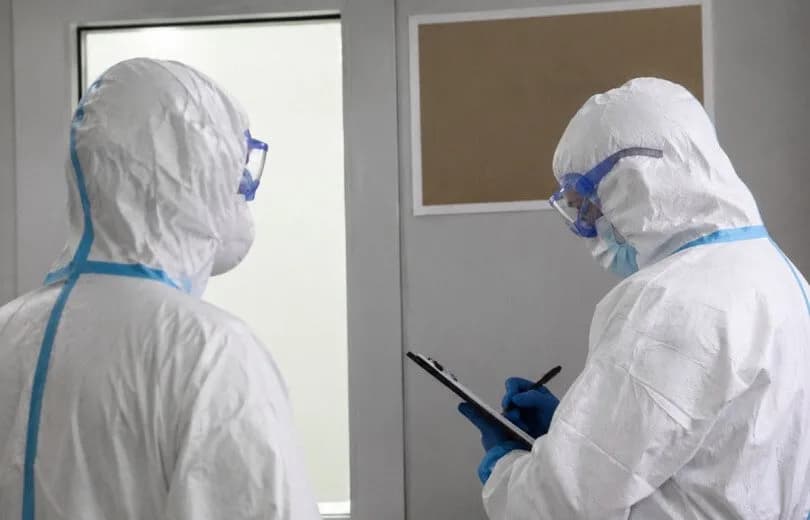












A 28-year-old worker at an anti-plague research institute in Siberia has died after developing severe pneumonia, prompting authorities to quarantine about 200 people and triggering international concern.
Russia has not confirmed that she had the plague. The worker, identified by Russian media as Darya Shipilova, died on October 2. Russia’s health regulator, Rospotrebnadzor, said she died from pneumonia of unknown origin.
It also said no microorganisms linked to her professional duties were found in samples taken from her. The case has nevertheless drawn scrutiny because she worked at the Irkutsk Anti-Plague Research Institute of Siberia and the Far East, where plague and other infectious diseases are studied.
The U.S. Embassy in Moscow has urged American citizens to leave Russia immediately (!) due to an outbreak of pneumonic plague. An official warning has been issued. United24 https://t.co/19MsiaQK9i
— Jürgen Nauditt 🇩🇪🇺🇦 (@jurgen_nauditt) October 7, 2026
Also Read | Nobel Prize in Medicine 2026: How 3 scientists unlocked the brain with light
Rumours abound, but the evidence remains coy

Questions began after conflicting accounts of how Shipilova became ill. One claim circulating online said she had broken a test tube containing live plague bacteria at work.
Russian authorities rejected that theory.
Other versions linked her illness to travel or a visit to an area near the Mongolian border. There is no public evidence supporting those explanations.
A regional official had earlier said Shipilova “may” have died from plague, but that was not a confirmation. The Russian response has instead focused on precaution.
Around 200 contacts were placed under medical observation, while hospitals and other facilities introduced containment measures.
By October 7, Rospotrebnadzor said around 90% of those quarantined had been released after nearly 5,000 laboratory tests failed to find dangerous pathogens among the contacts.
It also said Shipilova had been vaccinated against the infections she worked with.
Joseph Allen, professor at Harvard’s School of Public Health, says he’s concerned about the potential plague case in Russia as CNN learns a hospital is screening all patients: “It’s not normal, and it feels like they’re hiding something.” https://t.co/vfVGS1Xh8R
— Erin Burnett OutFront (@OutFrontCNN) October 7, 2026
What plague is

Plague is caused by the bacterium Yersinia pestis. It circulates naturally among some small mammals and their fleas.
Humans can become infected through infected flea bites, contact with contaminated material, or, in the pneumonic form, through respiratory particles from an infected person.
Pneumonic plague is the most severe form because it affects the lungs and can spread between people through respiratory particles. Without prompt treatment, it can become fatal very quickly.
Plague is treatable with antibiotics when it is diagnosed early. That combination explains the cautious response in Siberia. A suspected case involving a person working with dangerous pathogens can require rapid quarantine even when the diagnosis remains uncertain.
🚨🇷🇺 Russian authorities say reports of a second plague case linked to a Siberian lab are FALSE… Last week, Darya Shipilova, a 28-year-old lab worker at the Irkutsk Anti-Plague Research Institute of Siberia and the Far East, died in a hospital in Shelekhov near Irkutsk. Officials diagnosed “pneumonia of undetermined aetiology” (unknown origin). Russia’s national health agency says reports a second person fell ill are untrue, observation of contacts is complete, and no dangerous pathogens have been detected. Do you believe them? Writer: Samuel https://t.co/4P3JsthYZU
— Mario Nawfal (@MarioNawfal) October 8, 2026
Also Read | Messi farewell: ‘The whole world is grateful to you’ — Neymar’s tribute
WHO seeks answers, Russia plays down risk
The World Health Organization is now pressing Russia for more information rather than declaring an outbreak.
WHO said Russia had reported no recent plague cases in the Irkutsk region and had quarantined about 200 contacts. But the agency wants details of the tests conducted on Shipilova and those contacts, an explanation of what prompted the public-health measures, and updates on the health of the people monitored.
WHO has also sought verification of reports about a second employee with pneumonia of undetermined cause.
“We don’t yet have the full picture,” WHO Director-General Tedros Adhanom Ghebreyesus said on October 7. Russia, meanwhile, says there is no epidemic risk.
For now, the available evidence does not establish a plague outbreak in Siberia. The unresolved issue is the exact cause of Shipilova’s pneumonia and the reason for the unusually broad precautionary response.
Russia may have just unleashed plague on the world. No surprise there – China did just that in 2019. So why do we keep pretending that parchment agreements mean jack squat to our enemies? https://t.co/P87ZipwMqj
— Ben Shapiro (@benshapiro) October 6, 2026