
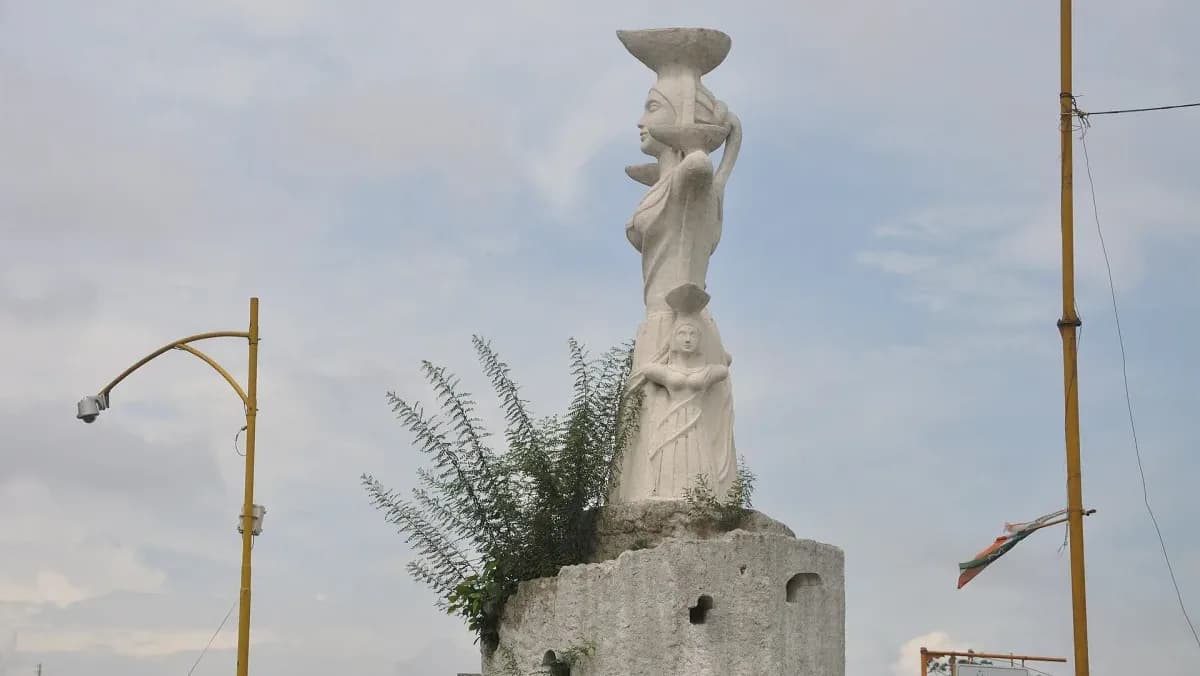



A piece of Kolkata’s artistic history has resurfaced after remaining hidden for nearly 12 years. Paroma, the 31-foot public sculpture conceptualised by artist Shanu Lahiri, was thought to have vanished after it was dismantled and removed from an Eastern Metropolitan Bypass roundabout in 2014. Now, the sculpture has been found in a private home in Tangra.
Paroma had become a familiar part of Kolkata’s landscape after it was installed in 1987. Its sudden disappearance on the night of November 24, 2014, had left the city with little more than rubble and several unanswered questions.
The sculpture survived, however, and was quietly preserved by Kolkata resident Hui Hao Howard Lee.
How Paroma Disappeared From Kolkata
Paroma stood on an important roundabout along the EM Bypass and was designed as a work of public art. Lahiri created the concept with other artists, including Manik Talukdar and Debojit Chakraborty, as well as young art graduates she had taught.
The sculpture was removed overnight in 2014. The Kolkata Metropolitan Development Authority, or KMDA, carried out the removal following an order from Firhad Hakim, who was then a minister in the West Bengal government and later became Kolkata’s mayor.
Hakim had said at the time that the sculpture was supposed to be relocated and that it had been broken down by mistake.
What happened next added another chapter to the story. A 200-kg metal globe carrying the Bengali letter “ব” was installed at the location after Paroma’s removal. For years, the fate of the original sculpture remained unclear.
Kolkata Man Found Paroma in the East Kolkata Wetlands
Paroma was not destroyed completely. A few days after it disappeared, Lee learned from his mother-in-law that a large sculpture resembling Paroma had been dumped in the Chowbaga area of the East Kolkata Wetlands.
Lee went to the location and discovered that it was indeed the missing artwork. “I saw some boys playing,” says Lee. He eventually brought the sculpture to his home in Tangra after paying the boys who had been looking after it.
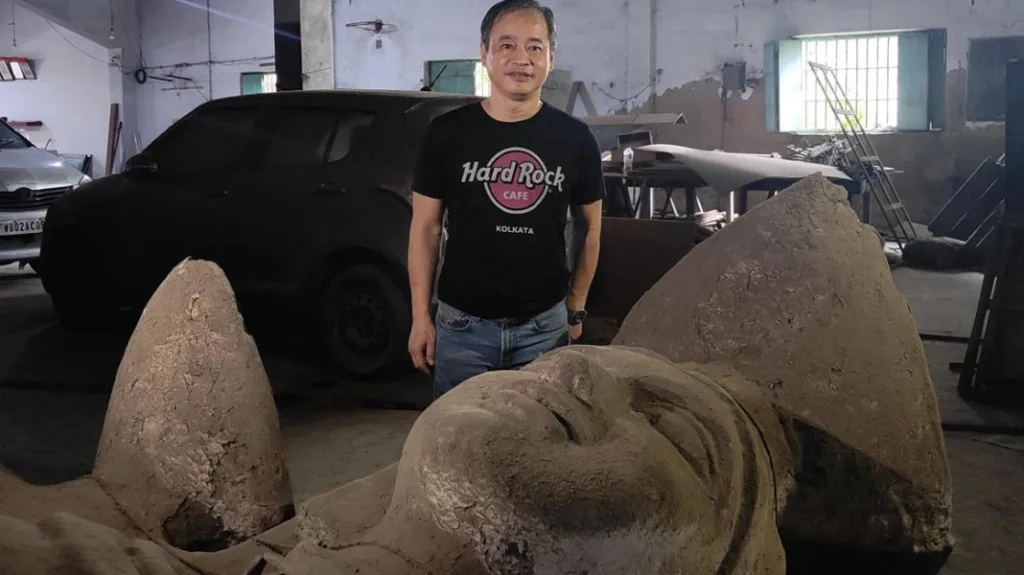
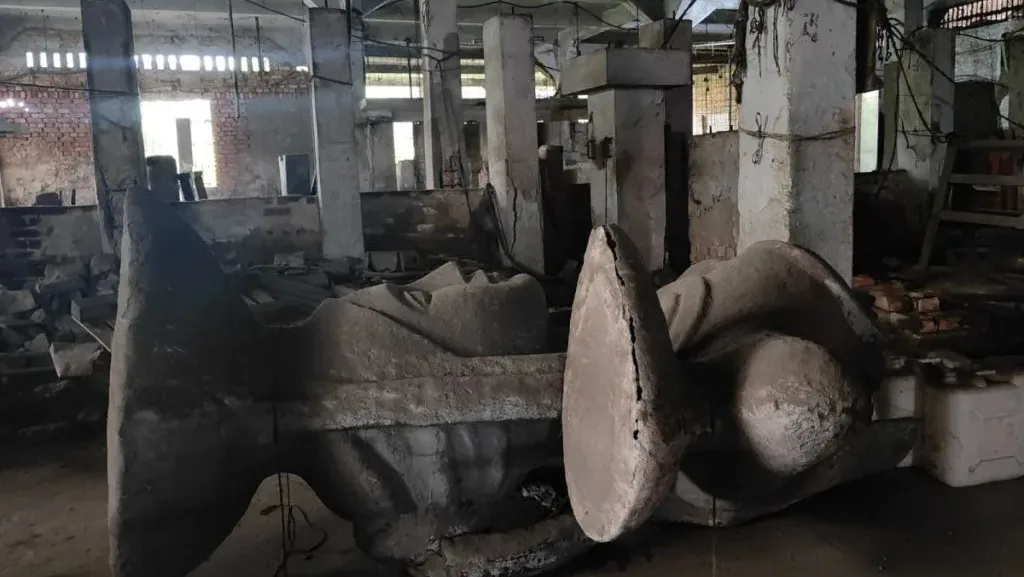
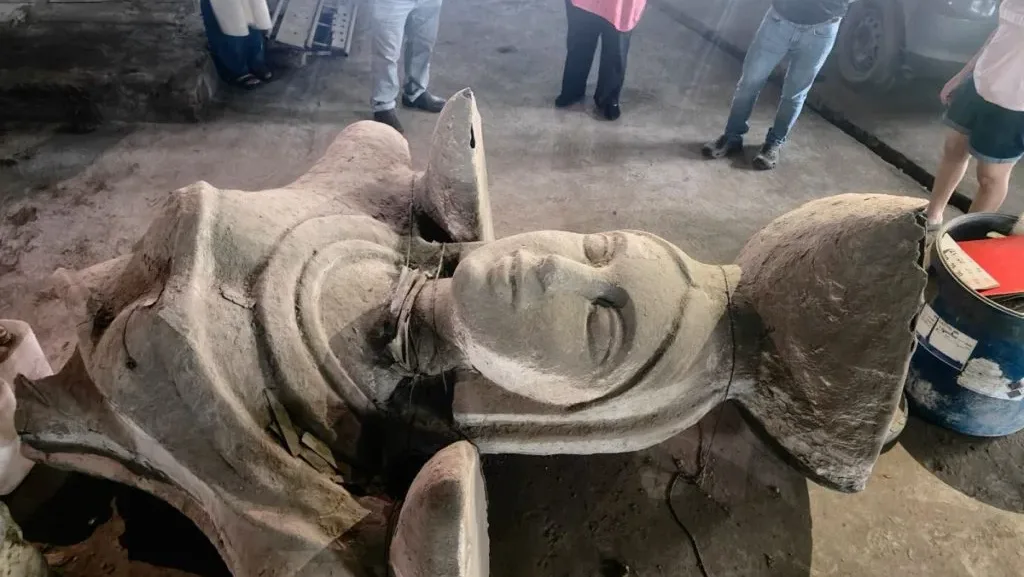
The recovered structure was considerably smaller than the original. The sculpture itself had been around 17 feet high and had lost roughly five feet. Its 14-foot brick-and-mortar base did not survive, but the fibreglass sculpture remained largely intact.
Lee kept it on the expansive floor of what was once his family’s tannery. He and his family continue to live in another part of the same building.
“I was overjoyed and relieved to find the sculpture,” says Lee. “I thanked God that I could salvage whatever was left of it. I even asked the boys to find the remaining parts,” he adds.
Paroma Was Part of Lee’s Childhood
For Lee, preserving Paroma was not simply about saving a work of art. The sculpture was part of his childhood in Tangra.
Lee grew up in the area when it had a much larger Chinese community. As children, he and his brother would climb the spiral base of Paroma.
“We had photographs of us on the statue,” says Lee.
He later developed an interest in Bengal’s art and became an avid collector. That connection helped him understand the significance of the sculpture he had rescued.
The story also reflects changes in Tangra and the East Kolkata Wetlands, both of which have undergone significant transformation over the years.
What Did Shanu Lahiri Create With Paroma?
Lahiri’s idea of public art went beyond simply placing a sculpture in an open space. Her works were intended to become part of everyday city life.
Paroma drew inspiration from the Bengali folk-art figure known as the Diwali putul, a form that combines the image of a woman or mother with a lamp and represents light and protection.
The sculpture was created with the involvement of several artists. Its large scale also made collaboration necessary. Private company GD Pharmaceuticals, known for Boroline, funded the project.
Paroma was therefore not a government-funded monument. It was created as a public artwork during the Left Front era in West Bengal and became part of Kolkata’s visual identity.
Children climbed its base, birds nested on it and passing motorists saw its silhouette against the city’s skyline.
Artists React to Paroma’s Recovery
Artist Chittrovanu Mazumdar, who is Shanu Lahiri’s nephew, recalled the shock surrounding its removal. “I had been shocked by its removal,” says Mazumdar.
But he believes the recovered sculpture cannot simply be treated as the same object that once stood beside the EM Bypass. “It is a fragment,” he reminds.
Mazumdar also spoke about the vulnerability of artworks and the damage caused when they are dismantled without care.
“Art has a natural difficulty to survive. Its materials are not durable,” says Mazumdar. “Taking a work of art down is a very violent act,” he says.
He noted that Paroma was a mother figure based on the Diwali putul, transformed into a large public sculpture. “It was something we were used to seeing every day,” he says Mazumdar.
Questions Over Kolkata’s Public Art
Art historian Tapati Guha-Thakurta believes Paroma’s recovery raises a larger question about how cities preserve public art.
“Another remarkable piece of art disappeared after Paroma’s removal. A Meera Mukherjee sculpture that was installed in Rabindra Sadan complex is not there any more,” Guha-Thakurta points out.
She also noted that the Somnath Hore sculptures at the Rabindra Sadan-Nandan complex do not appear to be well cared for.
Guha-Thakurta further pointed out that Paroma’s surroundings had already changed dramatically before the sculpture was removed. The open skyline that once surrounded it had given way to highrises and construction.
“So in a way, it was already not what it was previously,” says Guha-Thakurta.
That raises an important question for Kolkata: how should public art be protected, and who should take responsibility for preserving it?
Paroma’s Future Remains Uncertain
Nabina Gupta, artist, co-curator of the Shanu Lahiri exhibition and founder-director of Disappearing Dialogues, sees something fitting in the fact that a citizen and art collector rescued Paroma.
“It is so right that a citizen and an art lover, who has a personal connection with the piece of art, finds it and looks after it. It shows how art functions in society and how citizens shape the city’s thought process,” says Gupta.
Also Read | Calm restored at SRFTI campus after clash between students and ABGP
Ayana Bhattacharya, a PhD researcher associated with The Shanu Lahiri Archives, also stressed the need to preserve public art.
“But as a city we have not done a great job of preserving public art, irrespective of regime changes. Or of making space for enough public art engagements,” says Bhattacharya.
The question of what happens to the original site also remains open.
“The Biswa Bangla globe that replaced Parama has been altered already. What will finally come up in that place?” asks Bhattacharya.
She believes Paroma’s story should be preserved even if the sculpture itself cannot return to its original form.
“Paroma deserves to be archived and reframed as a practice. But it is a fragment,” she says.
A Paroma Replica Will Return During Durga Puja
While the original Paroma remains in Lee’s care, the artwork will once again appear in Kolkata in another form.
Damayanti Lahiri, Shanu Lahiri’s daughter, said that the Abasar Sarbajain Durga Puja pandal in Bhawanipore will feature a large replica of Paroma this year.
Damayanti had only recently learned that the original sculpture had survived. She was informed by a friend who is also acquainted with Lee’s family.
Also Read | Developments of fresh violence erupts at the SRFTI: Bricks and bottles hurled at students
Shanu Lahiri died in 2013, a year before Paroma disappeared. Asked how her mother might have responded to everything that happened to the sculpture, Damayanti offered a simple answer.
“She would not have been sentimental about it at all,” laughs Damayanti.
For Kolkata, however, Paroma’s survival carries a different significance. The sculpture that once stood in plain sight, disappeared without warning and remained hidden for more than a decade has now returned to the city’s cultural conversation. Its damaged form is a reminder of what was lost, but its survival also shows that a city’s memories can sometimes endure in unexpected places.