
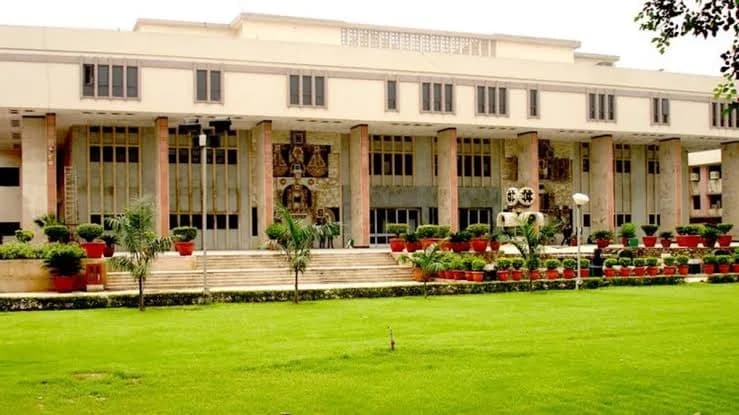












The Delhi High Court has upheld the Centre’s decision to deny an Indian visa to a US citizen of Indian origin who was convicted of a sexual offence in the United States. The Court said the government has the authority to prevent individuals convicted of such offences from entering the country, stressing that granting a visa is a sovereign function of the State.
Justice Amit Mahajan was hearing a petition filed by Dhanraj Rajendra Patel, who was born an Indian citizen but later acquired US citizenship after renouncing his Indian citizenship. Patel had challenged the repeated rejection of his applications for an entry visa to India.
The Delhi High Court noted that visa decisions involve considerations of national security, foreign policy and administrative discretion. It consequently refused to interfere with the government’s decision.
Delhi High Court says visa issuance is a sovereign function
The Delhi High Court observed that the issuance of a visa cannot be treated as an automatic entitlement, even when an applicant has personal or family ties to India. The Court emphasised that the government has considerable discretion in deciding who may be permitted to enter Indian territory.
Justice Amit Mahajan noted Patel’s conviction as a sex offender in the United States while examining the government’s decision. The Court held that the authorities were within their rights to prevent him from entering India.
The ruling underlines the distinction between citizenship rights and visa rights. Since Patel had surrendered his Indian citizenship after acquiring US nationality, his attempt to return to India was governed by the applicable visa and immigration framework.
Also Read | India bullet train delayed again: Why the Mumbai-Ahmedabad project is stuck

Patel had earlier travelled to India on an e-visa
Patel had travelled to India in December 2022 after obtaining an e-visa. However, on reaching Indira Gandhi International Airport in Delhi, he was intercepted by immigration authorities and subsequently deported to Dubai.
He later made several applications seeking an entry visa to India. According to the petition, those applications were returned, following which Patel approached the Delhi High Court.
Patel argued that the authorities had not given adequate reasons for rejecting his applications. He also claimed that he should be allowed to obtain an entry visa because he was married to an Indian citizen.
The Delhi High Court, however, did not accept this argument. The Court’s reasoning placed greater emphasis on the government’s authority over entry into the country and Patel’s criminal conviction in the US.
Also Read | INDIA bloc protest: 5 moments that turned Rahul Gandhi’s march into a standoff
Delhi High Court also noted earlier legal proceedings
While considering Patel’s plea, the Delhi High Court also took note of his failure to disclose that he had previously approached the Gujarat High Court regarding the denial of his entry into India and cancellation of his e-visa.
The omission was another factor considered by Justice Mahajan while examining the challenge to the government’s decision.
The case, titled Dhanraj Rajendra Patel & Anr v. Union of India & Ors, ultimately resulted in the Delhi High Court upholding the denial of an Indian visa to Patel.
The ruling reinforces the principle that entry into India by a foreign national remains subject to the government’s immigration and security considerations. The Delhi High Court’s observations also make clear that family connections to India do not, by themselves, create an enforceable right to obtain an Indian visa.
The case also highlights the wide discretion available to the executive in matters concerning the admission of foreign nationals into the country, particularly where national security, public interest or the applicant’s criminal background is relevant.