




![‘Possibly [be] needed in 90-120 days’: Why is the US checking Cuba readiness?](/_next/image?url=https%3A%2F%2Fd243y9xj05uh4.cloudfront.net%2Fwp-content%2Fuploads%2Fbengalinsight%2F2026%2F09%2F28034806%2FHTO03ZcXgAEX35j.webp&w=3840&q=75)



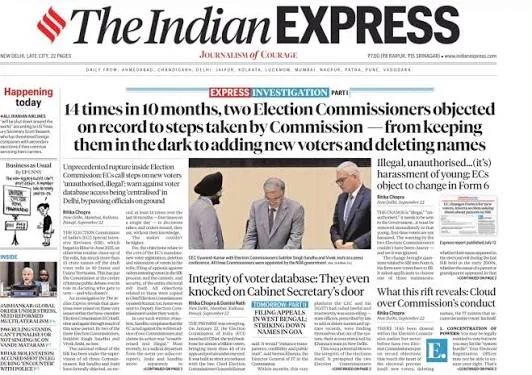
A Rs 81.45 lakh expenditure entry involving The Indian Express has triggered a political controversy over Congress’s election spending and its relationship with media organisations during the West Bengal Assembly elections. The payment, cited from Congress expenditure records, has been highlighted by critics amid a separate dispute over the newspaper’s recent reports concerning the Election Commission, electoral-roll revision and changes related to Form 6.
The controversy gained momentum after Supreme Court senior advocate Mahesh Jethmalani claimed on social media that the payment was evidence of a connection between Congress and The Indian Express. His allegation has been reported by the Navbharat Times. However, the existence of an expenditure entry and an allegation of editorial influence are two different things. The available expenditure record establishes a payment but does not by itself establish that Congress influenced the newspaper’s editorial decisions.
Congress’s payment to The Indian Express recorded during Bengal polls
The central figure in the controversy is Rs 81,45,780, which the cited Congress expenditure material records as a payment to The Indian Express during the West Bengal election period.
The timing has attracted particular attention because The Indian Express has recently been involved in a political dispute over its reporting on the Election Commission’s handling of the Special Intensive Revision of electoral rolls. Critics of the newspaper have questioned its coverage, while the Election Commission has rejected several interpretations surrounding its internal decision-making and Form 6.
The Congress’s payment to The Indian Express therefore became a talking point in the wider political debate. The organiser reported that the expenditure document establishes the payment but does not establish an editorial quid pro quo.
Congress, like other political parties, incurs substantial election expenditure on advertising, publicity and campaign-related activities. Recent expenditure reporting has also shown the scale of spending by other parties. For instance, The Indian Express reported that the BJP spent Rs 529.38 crore across the latest round of Assembly elections, including Rs 286 crore in West Bengal.
Also Read | LPU violence: Rape claim, student death and hostel demands explained

Congress’s payment to The Indian Express is part of wider media spending
The Bengal payment was not the only media-related expenditure cited in the material under discussion. The records also contain substantial payments involving other media organisations.
For Kerala, the entries cited include Rs 76.47 lakh to Veekshanam, Rs 42.48 lakh to Jaihind TV and Rs 28.37 lakh to The New Indian Express. The cited material puts these payments together at more than Rs 1.47 crore.
The records also point to expenditure involving Udayavani and India Express during the 2023 Karnataka Assembly election. The entries cited in the controversy amount to more than Rs 2.32 crore.
These figures provide context for the Congress’s payment to The Indian Express in Bengal. Political parties routinely use newspapers, television channels and digital platforms for election publicity. Consequently, a payment to a media organisation cannot automatically be treated as proof that its editorial coverage was purchased or directed.
That distinction is particularly important in the present controversy because the allegation of editorial influence goes beyond what the expenditure record itself demonstrates.
Also Read | What actually is the ‘virtue of higher seeding’? Here is how it helped India reach the semis of Asian Games
What the Rs 81 lakh record proves and does not prove
The political controversy has intensified because of the timing of the payment and The Indian Express’s recent reporting on the Election Commission.
The newspaper has published reports concerning disagreements or concerns raised during discussions within the poll panel over aspects of the Special Intensive Revision and Form 6. The Election Commission, however, has maintained that its final decisions were unanimous and has rejected suggestions that its internal discussions represented a breakdown in institutional functioning.
The BJP has also challenged aspects of the newspaper’s reporting, particularly claims concerning the authority of Electoral Registration Officers and the SIR-related material accompanying Form 6.
Against this backdrop, the Congress’s payment to The Indian Express has been cited by critics as a reason to question the newspaper’s relationship with the Congress party. Mahesh Jethmalani has gone further, describing the payment as evidence of a deeper connection. His claim is an allegation, rather than an established finding.
The available expenditure record establishes that money was paid. It does not establish that the payment was made in return for favourable coverage, that Congress dictated editorial decisions, or that a particular report was commissioned by the party.
Establishing such a link would require additional evidence beyond an election expenditure entry.
The episode nevertheless highlights a broader question about transparency in political advertising. Readers can reasonably distinguish between paid election publicity and independent editorial content, particularly when a media organisation is reporting on institutions and political issues that directly affect the parties funding election campaigns.
For now, the Rs 81.45 lakh figure remains a documented expenditure entry at the centre of a political dispute, while claims about its impact on editorial coverage remain allegations that require separate evidence.