

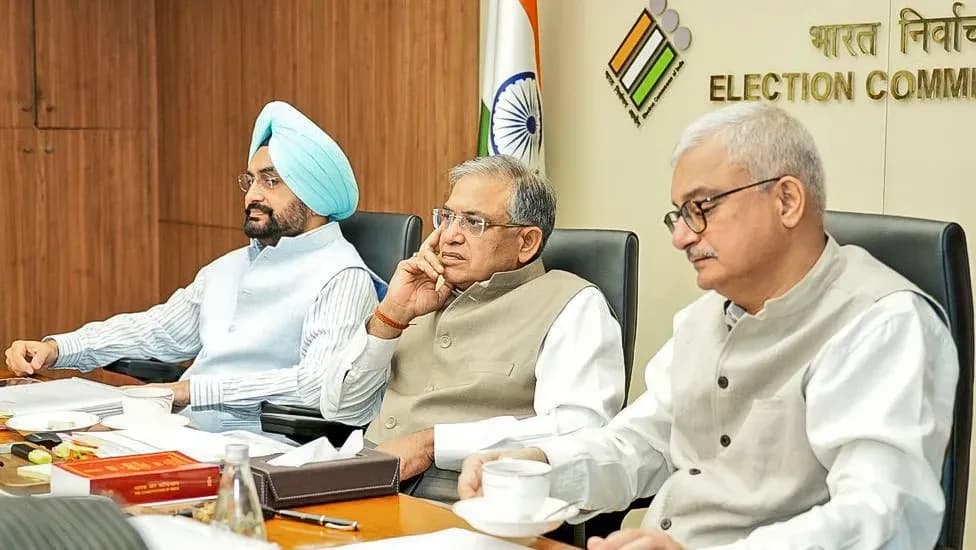










The Election Commission of India (ECI) is again facing questions over how decisions are taken when its three members do not agree. The issue has come into focus after Election Commissioners Sukhbir Singh Sandhu and Vivek Joshi reportedly recorded formal objections at least 14 times in 10 months over decisions linked to the Special Intensive Revision (SIR) of electoral rolls.
The ECI later said the objections were “part of decision-making process”.
But what happens when the Chief Election Commissioner (CEC) and the two Election Commissioners disagree? The answer lies in the Constitution and laws governing the poll panel.
What does Article 324 say?
Article 324(1) gives the Election Commission “the superintendence, direction and control of the preparation of the electoral rolls for, and the conduct of, all elections” to Parliament, state legislatures, and the offices of President and Vice-President.
Also Read | What is ERONET? The ECI software at the centre of the SIR row
The Supreme Court, in the 1977 Mohinder Singh Gill case, held that the ECI has broad powers under Article 324 and can act where there is no specific parliamentary law, provided its action does not conflict with existing legislation.
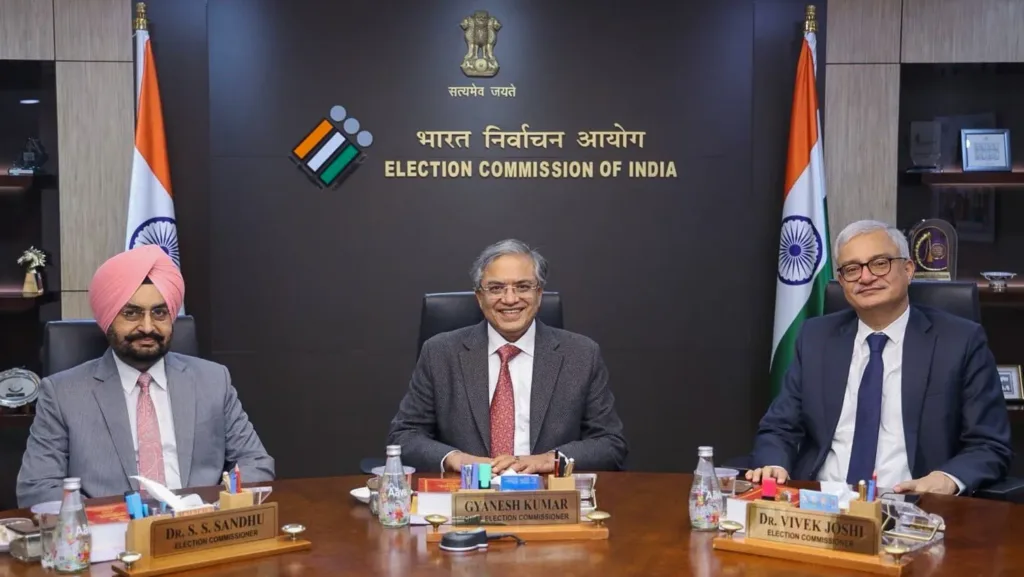
Article 324(2) allows the President to decide how many Election Commissioners the ECI will have. The commission functioned with only a CEC from 1950 to 1989. It has had one CEC and two Election Commissioners since October 1993.
Does the CEC have a veto?
No. The Supreme Court settled this question in the 1995 TN Seshan v Union of India case.
The court held that once additional Election Commissioners are appointed, the ECI operates as a multi-member body. The CEC does not have primacy or a veto over the other commissioners.
Under the decision-making framework, the commission seeks unanimity where possible. If its members disagree, the matter is decided by majority.
Also Read | ECI dissent report sparks Opposition attack as poll panel rejects formal dissent claim
The 2023 Chief Election Commissioner and Other Election Commissioners Act repealed the earlier 1991 law but retained this majority-based system.
How are the commissioners appointed?
The appointment system changed after the Supreme Court’s 2023 Anoop Baranwal judgment. The court had directed a selection panel comprising the Prime Minister, Leader of the Opposition and Chief Justice of India until Parliament enacted a law.
Parliament subsequently passed the 2023 Act. Its selection committee comprises the Prime Minister, the Lok Sabha Leader of the Opposition and a Union Cabinet minister nominated by the Prime Minister.
Can Election Commissioners be removed?
The CEC has protection similar to that of a Supreme Court judge and can be removed only through the prescribed parliamentary process.
Election Commissioners have a different safeguard. Under Article 324(5), they can be removed only on the recommendation of the CEC.