
















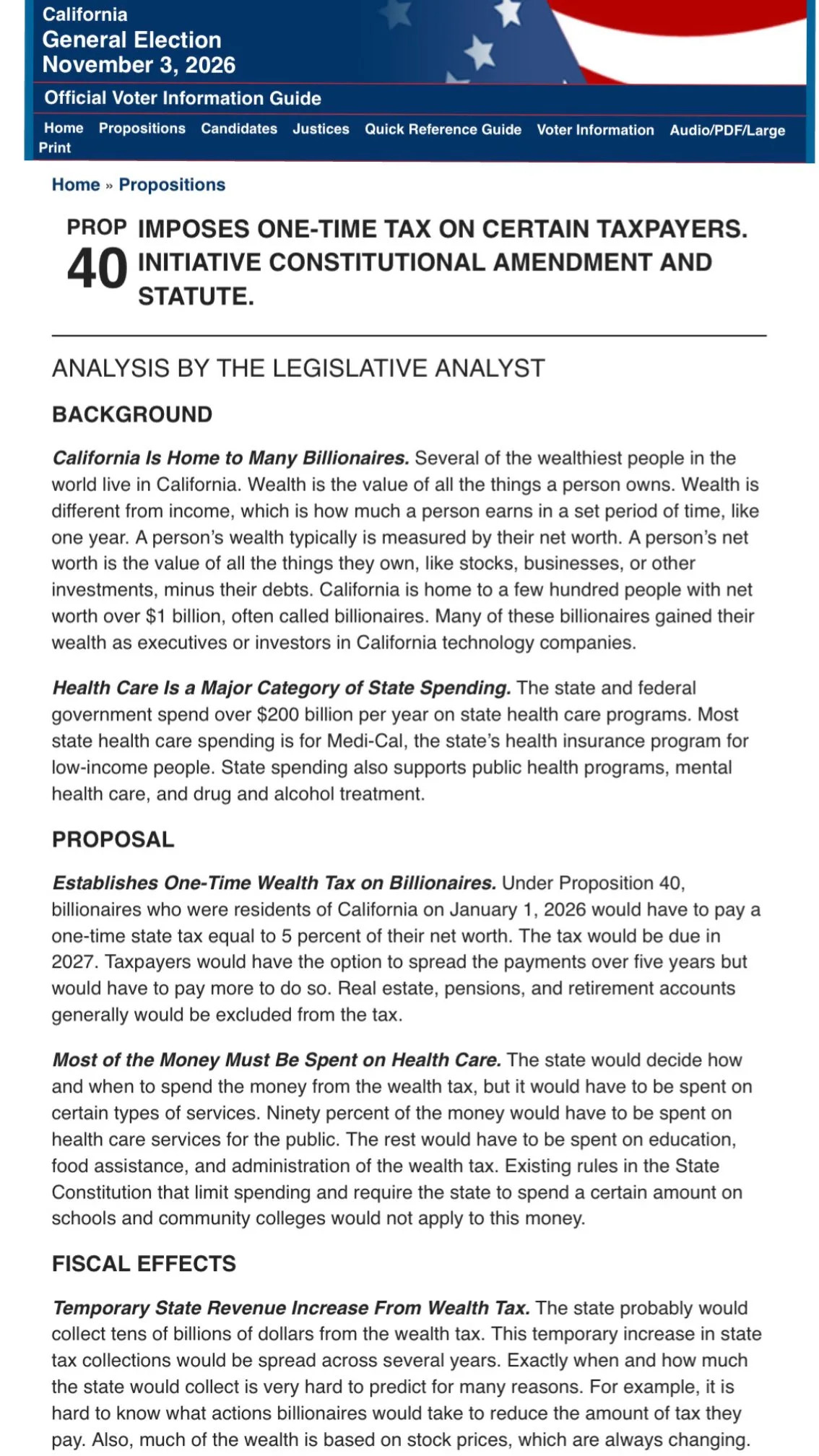
California is at the centre of a growing debate over how governments should tax extreme wealth. The state will vote on Proposition 40 on November 3, a ballot measure that would impose a one-time tax of up to 5% on certain taxpayers with more than $1 billion in covered assets.
The proposal is designed mainly to raise money for healthcare, while also directing part of the proceeds towards food assistance and education. California is home to roughly 250 billionaires whose combined wealth is estimated at more than $2 trillion.
1. The billionaires fighting a billionaire tax in California have created an AI-slop ad that shows the tax’s supporters assaulting kids and stealing their stuff. pic.twitter.com/L6PgmfUFAM
— Judd Legum (@JuddLegum) August 25, 2026
A different levy
The idea is different from a regular income tax. Income tax applies to money a person earns. A wealth tax applies to the value of assets a person already owns.
Under Proposition 40, the tax would apply to billionaires who were California residents on January 1, 2026.
Covered assets include businesses, securities, art, collectibles and intellectual property. Real estate, along with some pensions and retirement accounts, would generally be excluded.
The tax would be due in 2027, although taxpayers could spread the payment over five years at an additional cost.
The man behind the billionaire tax in California is unconvinced billionaires are actually leaving the state.
— Ashley Zavala (@ZavalaA) June 29, 2026
Gov. Newsom told me he personally knows at least a dozen.
"Their claims are entirely fabricated, there is absolutely no evidence.." SEIU-UHW Pres. Dave Regan told me pic.twitter.com/hw7ZXM14JT
Where the money could go
The argument from supporters is about where the money could go. The official voter guide says 90% of the revenue would have to be spent on healthcare services, with the remaining 10% directed towards food assistance, education-related programmes and administration.
Supporters have cited estimates of up to $100 billion in revenue. Some critics put the likely figure much lower, at around $40 billion.
The state’s Legislative Analyst’s Office, meanwhile, describes the expected revenue more cautiously as tens of billions of dollars spread over several years.
One of the worst aspects of California’s proposed billionaire tax is the signal it sends to young talented entrepreneurs solving big problems by saying to them: “Don’t bring your innovation and talent to California.” pic.twitter.com/bUIPMImFGa
— Rick J. Caruso (@RickCarusoLA) September 15, 2026
The sums differ, and so do the worries

That difference in estimates points to the larger economic argument around the proposal. Opponents say a wealth tax could encourage some billionaires to leave California or alter where they hold their assets.
That could reduce future state income tax revenue and investment. The Legislative Analyst’s Office estimates the possible ongoing loss in income-tax revenue at less than $1 billion a year.
California also has a long history of debate over tax-related ballot measures, including Proposition 30, which sought to raise taxes on high earners and was rejected by voters in 2022.
Gavin Newsom knows California can’t pass his billionaire wealth tax, so he’s been trying to push a national billionaire tax as well.
— Red Line News (@RedLineNewsUSA) September 18, 2026
His state is riddled with fraud, and he thinks blaming billionaires is the answer. What a joke. pic.twitter.com/ZpkhK0juUh https://t.co/rlkcqLIfGm
Heavyweight voices
Supporters dispute the idea that the tax would seriously damage California’s business ecosystem. University of California, Berkeley economist Emmanuel Saez, who helped write Proposition 40, described it as “a tax on billionaires to fund healthcare.”
He also argued that California’s universities, research base, infrastructure and pool of skilled workers would make a mass business exodus unlikely.
On the other side, Google co-founder Sergey Brin has emerged as a prominent opponent and has spent heavily on efforts to defeat the measure.
Governor Gavin Newsom also opposes Proposition 40 and has instead backed the idea of a federal wealth tax applied nationwide.
Taxing the rich is absolutely essential to saving our economy and our democracy.
— Robert Reich (@RBReich) September 20, 2026
Don't believe me? Look at this chart. pic.twitter.com/VhKIjBEWGF
Come November, California must weigh the trade-off
At its core, Proposition 40 asks a simple but difficult question: should California tax accumulated wealth, rather than relying primarily on taxes on income and spending?
The answer carries consequences beyond the billionaires directly affected. It could mean a large one-time injection of money for public healthcare and other programmes, but it also raises questions about future tax revenue, asset valuation and the behaviour of wealthy taxpayers.
California’s November ballot will put that trade-off directly before voters.